
The Supplier Relationship Management Playbook for GPO Members
How to build stronger supplier relationships and get even more value from your GPO membership — covering segmentation, performance, communication, and what to do when things go wrong.
- Supplier Relationship Management turns important supplier relationships into a structured source of performance, value, and risk management.
- Not every supplier requires the same level of attention; segmentation helps procurement focus resources where they matter most.
- Strong SRM covers performance, communication, quality, service, risk, and continuous improvement, not just price.
- A GPO contract establishes the commercial framework. SRM manages the relationship within that framework; a strong contract does not prevent service issues, quality drift, or slow issue resolution.
- Una can support supplier relationships at the level each member chooses from staying in the background to becoming directly involved when additional leverage is needed.
What is Supplier Relationship Management?
Most sourcing professionals learn the value of Supplier Relationship Management the hard way. Perhaps you had a supplier delivering exactly what you had agreed to, so you didn't give the relationship much attention.
Then things started to slip. Delivery times became less predictable, quality issues appeared, and small problems took longer to resolve. By the time you recognized a pattern, the relationship had deteriorated.
SRM is the structured process of managing important supplier relationships so they deliver the value and support your business needs. It covers much more than negotiating a contract or checking whether an order arrived on time. It involves deciding which suppliers deserve your attention, setting expectations, measuring performance, solving problems, communicating effectively, and looking for opportunities to improve the relationship over time.
A supplier relationship does not reach its full value when the contract is signed. The contract gives both sides a framework. What happens after that determines how well the relationship works in practice.
A useful starting question: Are we managing our supplier relationships, or are we simply managing transactions? The answer will probably be different across your supply base.
Transactional vs. Strategic Relationships
A transactional relationship focuses on the immediate purchase: is the price right, was the order delivered, was the invoice accurate? Those questions are necessary but they're only the beginning.
A strategic supplier relationship looks beyond the next order, considering service, risk, quality, future requirements, process improvements, innovation, and the supplier's role in achieving broader business goals.
Why SRM Matters
Price is often the most visible part of a supplier relationship, but it is rarely the only factor determining its value.
A supplier that offers a lower price but delivers inconsistently can create costs elsewhere in the business. Late deliveries can disrupt operations. Quality problems consume internal resources. Poor communication slows down issue resolution. An inflexible supplier can make it harder to respond when requirements change.
Then there’s value erosion. This chart from State of Flux shows the potential for SRM to deliver over and above the scope of the contract, while a lack of relationship management leads to dramatic loss of value over time.
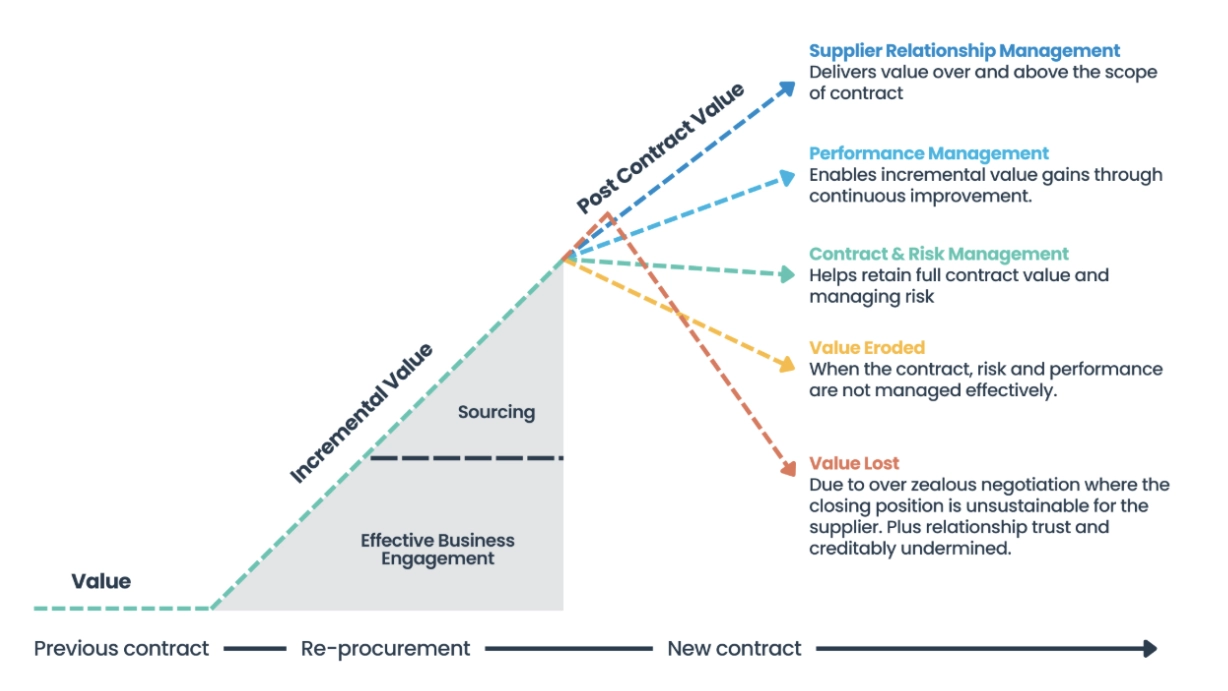
This is why good SRM looks beyond the original purchase. It gives procurement a way to think about the whole relationship and the contribution that supplier makes to the business.
When a supplier relationship is working well, issues can be identified earlier, conversations can move beyond price, and both sides have more context for making decisions. That becomes especially important when the supplier is strategic or difficult to replace.
What Can Go Wrong Without SRM
The absence of SRM usually shows up as a pattern of small problems.
Procurement spends time chasing late deliveries. The same quality issue appears more than once. A supplier increases prices and the conversation starts from scratch because nobody has been reviewing the relationship in the meantime. Internal stakeholders complain about service, but there is no agreed performance data to establish what is happening.
Over time, the organization becomes reactive.
SUPPLIER RELATIONSHIP WARNING SIGNS
- Supplier conversations happen mainly when something has gone wrong.
- Price has become the main topic of every supplier discussion.
- Nobody is clear about which suppliers should receive the most attention.
- Problems are fixed temporarily but keep recurring.
- Suppliers do not understand the organization's changing priorities.
- Useful supplier ideas never reach the people who could act on them.
When procurement focuses almost entirely on the immediate purchase, it can miss opportunities to improve efficiency, manage risk, and create additional value through the relationship.
SRM gives those conversations a structure.
Supplier Segmentation: Where to Focus
One of the biggest practical challenges in SRM is knowing where to focus.
A procurement team may manage hundreds or thousands of suppliers. Even with the help of AI, it isn’t realistic, or even useful, to try to give every relationship the same amount of time. A low-risk supplier providing a common product should not require the same management effort as a supplier that is critical to operations and difficult to replace.
Supplier segmentation provides a way to make that distinction. Most procurement teams use a simple 2x2 to segment suppliers by impact and risk.
LEVERAGE
High Impact · Lower Risk
May represent significant spend and offer more commercial options. Relationship management matters, but the approach can differ from a strategic dependency.
STRATEGIC
High Impact • High Risk
Critical to operations, difficult to replace, or important to longer-term business objectives. Typically deserves the most active relationship management.
NON-CRITICAL
Lower Impact · Lower Risk
Standard processes, automation, consolidation, or self-service typically make more sense than intensive SRM for this segment
BOTTLENECK
Lower Impact · Higher Risk
Spend may be small, but the supplier can create problems if supply stops. Priority is risk management and finding ways to reduce dependency.
What Makes a Supplier Strategic?
Spend alone does not tell you whether a supplier is strategic.
A supplier can be strategically important because it supports a critical process, provides a specialist capability, has limited alternatives, creates significant supply risk, or has the potential to contribute to future growth.
Consider the supplier’s operational importance, supply risk, business impact, innovation potential, and role in your broader organizational objectives.
ASK YOURSELF
- Would it be difficult to replace this supplier?
- What would happen if supply stopped for a week, a month, or longer?
- Does the supplier support a critical operation?
- Do they have expertise that would be difficult to replicate elsewhere?
- Could they help us improve a process or introduce something new?
- Is the relationship becoming more important as the business changes?
A supplier's classification can change too. An acquisition, a new location, a change in demand, or a disruption elsewhere in the supply chain can turn a relatively ordinary relationship into an important one.
SRM Best Practices
A good SRM program needn’t be complicated, but it does need to be consistent. Here are the four foundations of effective supplier relationship management.
Set Expectations Before Problems Appear
Both sides need to understand what good performance looks like.
For a logistics supplier, that might mean delivery performance and responsiveness. For a food supplier, quality, availability, and order accuracy may dominate.
Expectations should be clear enough that both sides can recognize when performance is slipping.
Measure What Matters
Supplier KPIs create a shared basis for performance conversations.
Common measures include on-time delivery, quality, order accuracy, contract compliance, responsiveness, invoice accuracy, and issue resolution.
The right scorecard should reflect the supplier's role. Remember, there’s little value in creating a laundry list of metrics that nobody uses.
Commmunicate Regularly
Strategic suppliers need enough contact to understand what is changing.
Establish a rhythm that fits the relationship. A critical supplier may warrant regular business reviews, while a lower-risk supplier may need occasional check-ins.
The frequency matters less than the quality of the conversation.
Look Beyond Price
SRM gives procurement a way to consider the full value of the relationship.
Can the supplier reduce waste, improve service, simplify an internal process, support resilience, introduce a better product, or help reduce total cost rather than simply reducing unit price?
These conversations rarely happen if the only interaction is an order and an invoice.
The Supplier Experience Matters Too
Ask yourself, "Am I a good customer?"
Consider what it’s like to work with your organization. Are requirements clear? Are internal stakeholders aligned? Is onboarding straightforward? Are questions answered promptly? Do suppliers know who to speak with? Are payment processes predictable?
A poor customer experience can weaken relationships and increase risk, particularly when suppliers have to decide how to allocate limited resources during periods of disruption.
Measuring Supplier Relationship Performance
Not every supplier relationship needs a complex scorecard, but procurement needs enough information to understand whether the supplier is performing as expected and where improvement is needed.
Category
Key Metrics
Performance
On-time delivery, quality, availability, responsiveness, order accuracy, service levels
Commercial Value
Negotiated savings, cost improvement, invoice accuracy, contract compliance
Risk
Supply disruption, dependency, corrective actions, visibility into emerging risks
Strategic Contribution
Process improvements, innovation, new opportunities, progress against broader business objectives
Start the Relationship Properly
SRM should begin during supplier onboarding rather than months after the supplier has started delivering.
The onboarding process establishes the basic conditions for everything that follows.
Roles should be clear, expectations should be understood, and both sides should know how day-to-day questions and larger issues will be handled.
Make sure you provide the information, structure, and support suppliers need without making the process unnecessarily complicated.
ANSWER A FEW BASIC QUESTIONS:
- Who owns the relationship?
- What does the supplier need to know about the business?
- How will orders, invoices, and communications work?
- What performance measures will be used?
- How will issues be escalated?
- When will the relationship be reviewed?
What to Do When a Supplier Relationship Goes Wrong
Even the strongest supplier relationships experience problems.
A supplier may miss delivery targets. Quality may decline. Costs may increase. Communication can break down. Internal requirements may change. External events can put pressure on the supply chain.
Your first response should be to understand what has changed, then focus on direct communication, trust, clear expectations, and collaboration.
1.
Identify the Problem
Be specific about what has gone wrong and how it is affecting the business.a member.
2.
Find the Cause.
Look beyond the immediate symptom and determine whether the issue comes from the supplier, your own processes, unclear requirements, or external conditions.
3.
Discuss it Directly.
Give the supplier an opportunity to respond and provide context.
4.
Agree on Corrective Action.
Define what needs to change, who owns it, and when it will happen.
5.
Monitor the Result.
Measure whether performance has improved and whether the underlying issue has been resolved.
Supplier Relationship Management for GPO Members
There’s an assumption that once a supplier is covered by a GPO contract, the GPO takes over supplier relationship management.
Here’s how it works:
The GPO Contract
Establishes the commercial framework — pricing, terms, conditions, and agreed rates. It gives both sides a strong starting point for the relationship.
Your SRM Program
Manages the relationship within that framework — service levels, quality, communication, issue resolution, and continuous improvement. A strong contract does not prevent these things from slipping.
GPO members still need to monitor performance, maintain communication, and manage supplier relationships. The supplier still has to deliver.
GPO members should ask the same SRM questions they would ask of any supplier: Are service levels being met? Is quality consistent? Are invoices accurate? Are problems being resolved quickly? Does the supplier understand changing business needs?
How GPO Members Can Use SRM
There's no single model for managing a supplier through a GPO. Some members have experienced procurement teams and want to manage relationships directly, using the GPO contract as the commercial foundation. Others prefer more hands-on GPO support particularly for service issues or when additional supplier leverage is needed. Many use a combination of both.
The important point is that using a GPO does not require the member to give up ownership of the relationship. Think of the GPO as an extension of your procurement team. Your team manages the day-to-day relationship while the GPO provides support when it adds value.
How Una Members Use SRM
Two member examples illustrate different ways to integrate GPO contracts with existing supplier relationships.
CASE STUDY
Campus Cooks: Adding Leverage Without Replacing Relationships
Campus Cooks had established relationships with local food vendors across its network. Those relationships were important to its operations, but the company also wanted better pricing and greater purchasing leverage.
Working with Una provided access to national food contracts while allowing existing local relationships to remain in place. This demonstrates that a GPO contract can add commercial leverage without requiring you to give up relationships that work.
CASE STUDY
YPurchasing: Let the GPO work in the background
YPurchasing already had its own supplier network and a focus on serving its YMCA members.
The organization used Una to identify savings opportunities in food distribution while allowing Una to work in the background with food vendors.
That model illustrates another way to use a GPO: the member retains ownership of its broader supplier environment while the GPO provides support where it can add value.
The SRM Checklist for GPO Members
Use this checklist to assess the maturity of your supplier relationships and identify where more structure could create value.
Supplier Strategy
Have we identified which suppliers are strategically important?
Have we segmented suppliers according to business impact and risk?
Are we spending the most SRM time on the suppliers that matter most?
Does each important supplier have a clear internal owner?
Are our preferred suppliers still aligned with current business needs?
Selection & Onboarding
Did we evaluate important suppliers on more than price?
Did we assess capability, quality, capacity, financial stability, communication, and fit?
Does each supplier understand our expectations?
Is onboarding straightforward?
Do suppliers know how to escalate issues?
Performance
Have we agreed meaningful KPIs?
Do we review supplier performance regularly?
Can we identify recurring problems?
Are corrective actions tracked through to completion?
Are we measuring total value rather than price alone?
Relationship
Do strategic suppliers understand our business priorities?
Do we communicate often enough?
Are supplier meetings focused on performance and opportunities?
Are suppliers encouraged to bring forward ideas?
Do we know when a relationship needs more attention?
Supplier Experience
Are our requirements clear?
Are our internal processes easy for suppliers to navigate?
Do we communicate important changes early?
Are we paying suppliers according to agreed terms?
Would our strategic suppliers describe us as a good customer to work with?
Risk & Resilience
Which suppliers are critical to business continuity?
Where are we dependent on a single source?
What would happen if a critical supplier failed?
Do we have enough visibility into supplier risk?
For GPO Members
Are we continuing to manage supplier performance after adopting a GPO contract?
Are we maintaining the direct supplier relationships that matter to us?
Do we know when to handle an issue ourselves and when to involve our GPO?
Are we using our GPO’s supplier relationships and leverage when they can add value?
Are we getting the full benefit of the commercial agreement while continuing to manage the relationship?
How Una Supports Supplier Relationship Management
Una can provide support when a member has a supplier issue, needs additional leverage, or wants help navigating a category. Here's what Una brings to supplier relationship management:
A stronger commercial starting point.
Una gives members access to pre-negotiated supplier contracts backed by $100 billion in collective buying power.
Supplier relationships and leverage.
Members gain access to an established supplier network with established national account relationships.
Control stays with the member.
Members can maintain direct supplier relationships and decide which contracts to use. Una does not take over relationships without invitation.
Support when it is useful.
Una's Member Experience team can help when supplier performance or service issues need attention or when additional leverage is needed.
More capacity for procurement.
By taking sourcing and negotiation off your team's plate for indirect categories, Una gives you more room to focus on strategic supplier management.
The relationship can be as hands-on or hands-off as the member needs. Una can work in the background while you maintain full supplier relationships or step in directly when support adds value.
Ready to Get More From Your Supplier Relationships?
A supplier contract gives you agreed terms. Strong supplier relationship management turns those terms into sustained performance, better service, stronger resilience, and additional value.
Una can provide the commercial leverage, supplier relationships, and support you need while leaving you in control of how those relationships are managed.