

Scroll through LinkedIn on any given morning and you will find an abundance of passionate advocacy for the supply chain profession. It isn’t uncommon to see campaigns targeted at university business graduates, framing modern procurement as an excellent career path.
The pitch describes a role where young professionals act as corporate detectives uncovering data insights, master negotiators forging global partnerships, and sustainability champions saving the planet, one contract at a time.
It sounds like a marvelous career to recommend to the next generation, offering high impact and intellectual variety.
Yet, I find myself viewing these pitches through the lens of a parent. The picture being painted for young talent is attractive, but we need to confront the massive, AI-shaped elephant in the room.
Knowing what we know about the future of white-collar jobs, should we still encourage young people to enter the procurement profession today?
The AI Reality Check
The optimistic argument for talent acquisition is that AI will simply liberate human workers from mundane tasks. The theory suggests that technology will automate the boring paperwork, leaving a pristine landscape of high-level strategic sourcing and relationship building for everyone.
This perspective feels increasingly naive. The sheer velocity of generative AI, specialized LLMs, and autonomous software agents suggests a far more disruptive outcome for the corporate hierarchy.
We’ve moved well beyond basic optical character recognition software that scans invoices. Modern AI agents can read a complex contract, cross-reference it with historical market data, compare it against global compliance standards, and draft a flawless, context-aware negotiation strategy in seconds.
The technology is hurtling past the role of a helpful digital assistant, operating instead as a highly competent, tireless competitor for cognitive tasks.
The Hollowing Out of Entry-Level Roles
The immediate threat to a nascent procurement career is not the sudden replacement of the Chief Procurement Officer by a server rack. The true disruption is happening right now at the bottom of the career ladder, manifesting as a severe hollowing out of entry-level positions.
Anthropic CEO Dario Amodei warned that artificial intelligence could eliminate roughly 50% of entry-level, white-collar jobs within five years, potentially spiking unemployment to between 10% and 20%. He noted that “knowledge worker” roles are particularly vulnerable to automation as AI becomes capable of human-level reasoning.
Historically, young professionals learned the nuances of procurement by doing the heavy lifting in foundational roles.
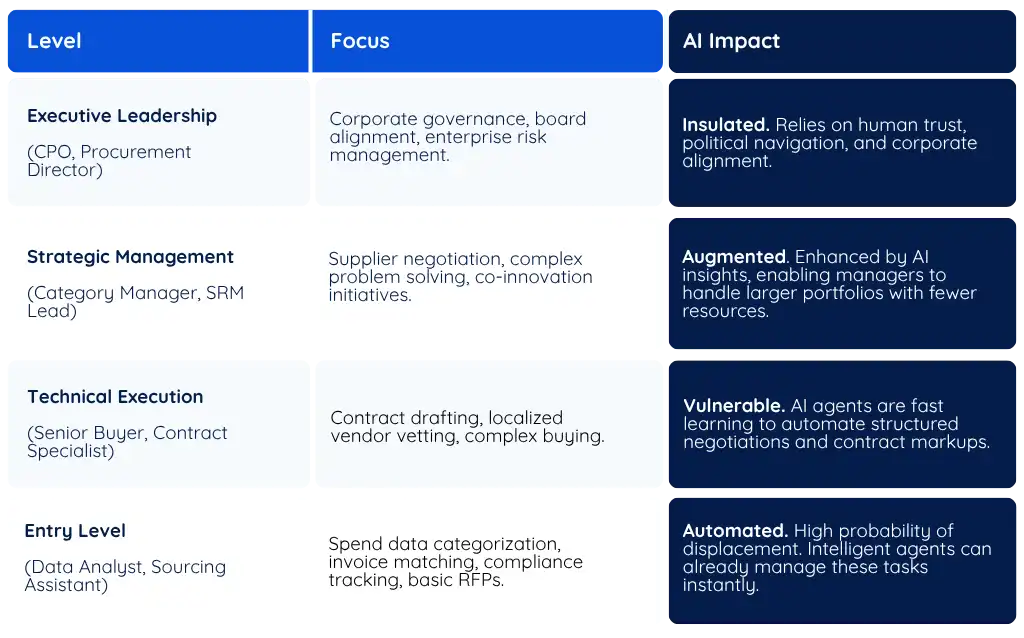
Junior buyers, contract administrators, and spend analysts cut their teeth on repetitive, structured work. They spent their formative years running basic data consolidation, flagging invoice variances, updating supplier databases, and drafting standard RFPs. These tasks were admittedly tedious, but they served a vital educational purpose: handling the administrative minutiae was exactly how a junior professional developed market intuition, learned supplier behavior, and built commercial acumen.
Today, those same entry-level tasks represent prime real estate for automation. An autonomous AI agent can categorize a million lines of fragmented spend data or generate standard compliance reports with zero human intervention.
Consequently, organizations are quietly shrinking their intake of junior headcount. Why hire three graduate analysts when a specialized procurement agent can process five times the volume?
This trend creates a precarious structural gap, removing the very stepping stones young professionals need to climb into senior, strategic roles. We risk creating a profession that still has room at the top, but no way to get there from the bottom.
The Procurement Professionals of the Future
If the traditional operational runway is disappearing, the procurement professional of tomorrow will look vastly different from the buyer of today. The role will likely split into two distinct areas: orchestrators (tech-focused) and relationship specialists (people-focused).
Procurement Orchestrators
On one side, we will see the emergence of the Procurement Orchestrator. These individuals will not necessarily be experts in negotiating logistics contracts or sourcing raw materials. Instead, their primary skill will be algorithmic orchestration. They will spend their days managing, auditing, and prompting networks of autonomous AI sourcing agents, ensuring the technology aligns with corporate governance and ethical guardrails.
Relational Specialists
On the other side sits the Relational Specialist. This role belongs to individuals who excel at human capabilities. AI can optimize a spreadsheet or draft a contract clause, but it cannot navigate a tense, emotionally charged dispute with a critical sole-source supplier. It cannot build genuine trust, understand cultural nuances during a global supply chain crisis, or co-create shared innovation goals over a face-to-face dinner.
The future belongs to hyper-specialized orchestration and deep relational management, but leaves little room for the generalist administrative roles that defined procurement for generations.
Elevating Human Agency in an Automated Ecosystem
If the machine can handle the execution of data, we need to pivot to elevating the unique power of human agency. True procurement innovation in the future will be measured by how effectively we wield the strategic influence that machines lack.
Elevating human agency means shifting the core of procurement training away from administrative compliance and toward leadership, ethics, and critical thinking. We need to cultivate professionals who look at data not just to see what happened, but to challenge the underlying corporate assumptions. Humans possess the unique capacity for moral reasoning, commercial intuition, and creative risk-taking.
While an AI can calculate the most cost-efficient supplier based on historical data, only a human can look at a geopolitical trend or a shifting societal value and make a nuanced, ethical judgment call to pivot the entire supply chain.
We have a rare opportunity to transform procurement professionals into genuine corporate architects by stripping away the low-value transactional noise. The future belongs to those who use automated efficiency as a launchpad for deep strategic influence.
Back to That Question…
This brings us back to the fundamental dilemma facing every parent looking toward the horizon.
Would you (still) encourage your kids to pursue a career in procurement - or any white-collar role, for that matter?
Personally, I’d offer them a clear-eyed warning that the linear corporate climb is an obsolete strategy, with the comfortable path of starting as a data clerk and slowly absorbing knowledge over a decade now gone.
Yet, beneath that warning lies an exciting frontier. If they choose this field, they must be comfortable with constant disruption and willing to continuously reinvent their value proposition. For those who embrace that challenge, the rewards will be immense, because we could argue that AI is actually elevating procurement to its most impactful form.
For more content and resources to help you pursue procurement as a career, check out Una's online resource center.


