

In a quiet corner of a mid-sized manufacturing firm in Ohio, a lead engineer recently sat on a design that could reduce raw material waste by 30 percent. He didn’t share it with his purchasing manager. When asked why, his answer was telling. He said the current contract is so rigid that suggesting a change feels like a legal battle rather than an opportunity.
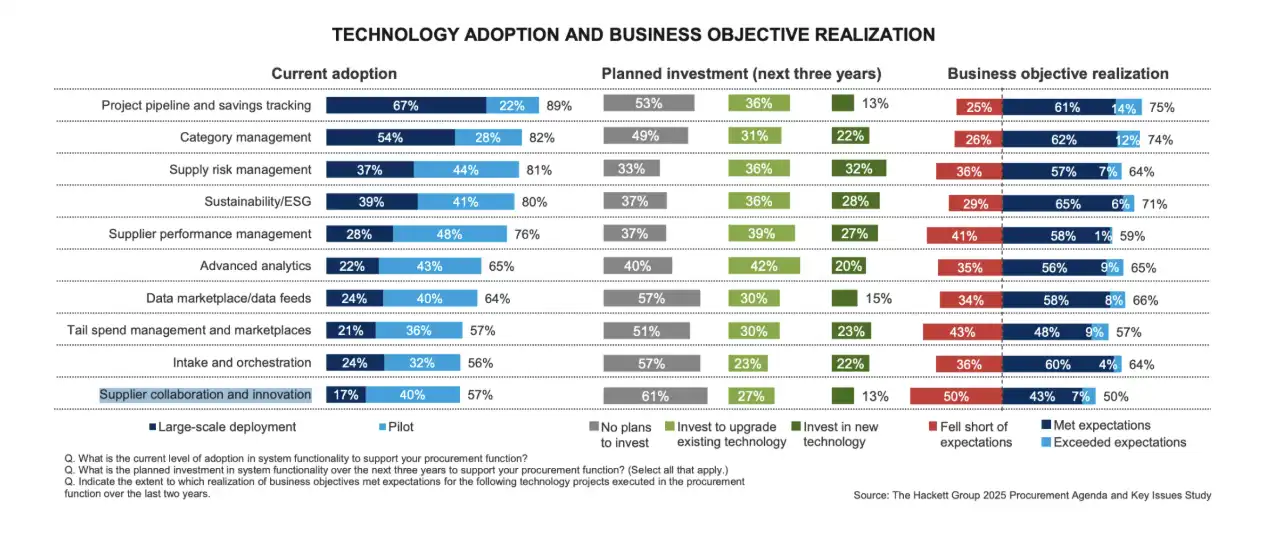
This is a quiet crisis in American business. A recent study by the Hackett Group shows that while 57% are currently adopting supplier collaboration/innovation initiatives, 50% of these investments fell short of expectations.
6 Ways You're Stifling Supplier Innovation in Procurement
We claim we want the next big idea. We say we want partners who think outside the box. Yet, the way we build our processes often acts as a cage for the very creativity we hope to attract.
Here are the ways you might be unintentionally stifling the brilliance of your supply base.
1. You are obsessed with the "How" instead of the "What"
When you send out an RFP that is forty pages of hyper-specific technical requirements, you leave zero room for a supplier to tell you there is a better way. You are essentially hiring a pair of hands instead of a brain.
If you tell a logistics provider exactly which routes to take, they will never suggest the alternative fuel network that could save you thousands in carbon taxes.
How to unleash innovation? Focus on the desired outcome and let the experts figure out the path to get there.
2. Your payment terms are an innovation tax
It is difficult for a small, agile startup to pitch you a revolutionary software solution if your standard operating procedure is Net-90 payment terms. By the time the check arrives, that startup might not exist anymore. Long payment cycles force suppliers to focus on their own survival rather than your long-term growth. You are effectively filtering out the most innovative players in favor of the ones with the largest bank accounts.
3. You treat every contract like a final destination
Innovation is a moving target. If your contracts are locked in for five years with no mechanism for mid-term adjustments or pilot programs, you have built a wall around your business. Suppliers will stop bringing you new ideas if they know those ideas cannot be implemented until the next decade.
Consider creating "innovation clauses" that allow for small-scale testing of new concepts without reopening the entire legal framework.
4. The scoreboard is only calibrated for price
If your procurement team is only incentivized on cost savings, they will naturally view supplier innovation as a threat to their metrics. Innovation often requires an initial investment or a shift in value perception that goes beyond the unit price. When the only way a supplier can "win" is by being the cheapest, they will eventually stop trying to be the best.
5. You are keeping your cards too close to your chest
Suppliers are not mind readers. If you treat your business challenges like state secrets, you are effectively preventing your partners from solving them. Many procurement teams operate on a need-to-know basis, providing only the bare minimum of data required for a quote. This is a mistake. When you share your five year roadmap or your most persistent operational pain points, you give suppliers the context they need to offer proactive solutions.
A supplier might have a patent or a process that directly addresses your biggest bottleneck, but they will never pitch it if they do not know the bottleneck exists.
6. There is a professional blocker on your team
Sometimes the hurdle is not a process, but a person. Every organization has at least one individual who believes their primary responsibility is to protect the status quo. These blockers view new ideas as risks to be mitigated rather than opportunities to be explored. They use compliance and policy as a shield to say “no” to any suggestion that deviates from the standard routine.
If your team culture rewards people for avoiding mistakes more than it rewards them for finding improvements, you have built an environment where innovation goes to die. Empower your team to be scouts for new ideas instead of just guards of the old ones.
Innovation is a Native Feature of the GPO Model
There is a common misconception that joining a group purchasing organization means sacrificing your voice or your ability to innovate. In reality, the opposite is true.
Because a GPO like Una has already handled the heavy lifting of the initial negotiation and the exhausting haggling over base pricing, you are free to focus on the high-value work. You maintain a direct relationship with the supplier, but your conversations shift from fighting over pennies to finding the best ways to work together.
By leveraging a pre negotiated contract, you bypass the months of administrative friction that can kill a new idea before it starts. You have the bandwidth to pilot new sustainable packaging with your office provider or test a new inventory management system with your industrial supplier. You are a customer backed by the collective influence of a massive network, which often makes suppliers more willing to bring their newest and best ideas to your door.
Are you giving your suppliers the transparency they need to help you win, or are you still keeping them at arm's length?


