There's an old idea in toxicology: the dose makes the poison. Water is essential to life. Drink enough of it fast enough and it will kill you.
The same logic applies to data and procurement teams are learning this the hard way.
Spend analytics platforms, ERP outputs, supplier scorecards, contract management systems, market intelligence dashboards: the data is everywhere, and the instinct is to collect more. More data means more visibility. More visibility means better decisions.
Except when it doesn't.
Data Burnout in Procurement
At a certain point, data stops informing decisions and starts delaying them. Teams spend more time reconciling numbers than acting on them. Leaders wait for one more data point before making a call they could have made a week earlier. Analysts disappear into spreadsheets and surface days later with findings nobody has time to read.
This is data burnout and it's more common in procurement than most people want to admit.
The Data Paradox
Good spend visibility is the foundation of strategic procurement. You cannot negotiate effectively, identify savings, or manage supplier risk without it. But the volume of data available to procurement teams has grown faster than most organizations' ability to make sense of it.
The result is a paradox: the more data you have, the harder good decisions become.
Researchers call this analysis paralysis. In procurement, it shows up as delayed sourcing events, postponed contract renegotiations and spend category reviews that never quite get finished. The data is there. There's just too much of it, and nobody is sure which parts to trust.
Where the Overload Comes From
A few patterns tend to create the problem.
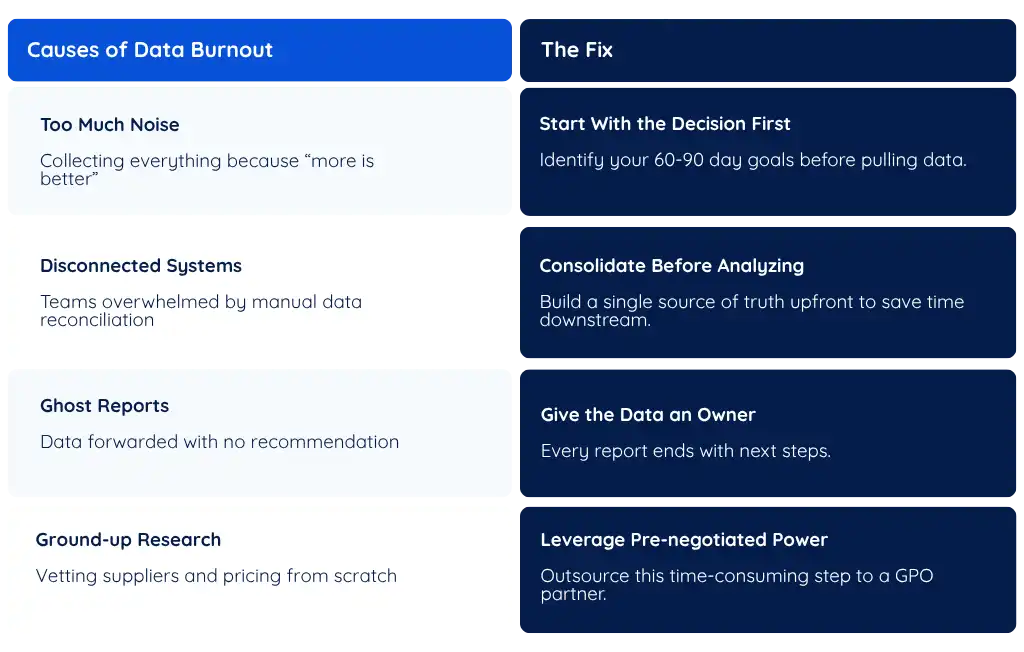
- Disconnected systems. Spend data lives in one platform, contracts in another, supplier performance in a third. Before you can analyze anything, someone has to pull it all together manually. That reconciliation work is time-consuming, error-prone and often happens before anyone has thought about which question they're actually trying to answer.
- Reporting for reporting’s sake. When data is available, the instinct is to report on all of it. Weekly spend reviews, monthly scorecards, quarterly supplier reviews: each one makes sense in isolation, but collectively they consume hours that could go toward getting things done. Reports that no one reads are an under-appreciated drain on procurement capacity.
- Data without a decision owner. Information without interpretation is noise. When no one is clearly responsible for turning numbers into a recommendation, teams default to forwarding the data and hoping someone draws the right conclusion. That rarely works in practice.
The AI Acceleration (And Why It Isn't a Cure-All)
The rise of advanced procurement systems, specifically AI and machine learning, offers a solution to the data bottleneck. AI can vastly improve the speed of data gathering and reporting. It can scan thousands of supplier invoices in seconds, clean up messy categorization errors instantly, and automatically generate monthly spend reports that used to take analysts days to compile.
But there is a catch.
While AI can supercharge the velocity of your reporting, it does not automatically improve the utility of your decisions. In fact, if deployed incorrectly, AI can also accelerate data burnout.
The core paradox remains: speed without strategy is just faster noise. Technology is a powerful tool to streamline the manual labor of data aggregation, but it cannot replace human judgment. It should be used to free up time for strategic decision-making, not to create a firehose of automated reports that nobody has the bandwidth to read.

Sharpen The Focus
The solution is to sharpen our focus. A few things consistently help.
- Start with the decision, not the data. Before pulling any reports, ask what decision the data needs to support. What are you trying to decide in the next 60 to 90 days? Work backward from the decision to identify which data points actually matter, and leave the rest for later.
- Consolidate before you analyze. If your team is spending significant time pulling data together from multiple systems before any analysis can happen, the problem is upstream. Consolidating spend data into a single source of truth is tedious, but this upfront work pays off quickly in time saved downstream.
- Give the data an owner. Someone needs to be responsible for translating data into a recommendation, not just producing the data. The output should be actionable: "based on what we're seeing, here's what we recommend doing next."
- Pre-negotiate more and research less. One of the biggest drivers of data overload in procurement is the time teams spend vetting suppliers and gathering market pricing from scratch, for every category and every sourcing event.
Where a GPO Changes the Equation
This is one of the most compelling arguments for working with a group purchasing organization. Una's model is built around eliminating the research burden for procurement teams.
Instead of spending weeks vetting suppliers, gathering pricing data and negotiating contracts from scratch, Una members access more than 2,500 pre-negotiated supplier agreements across a wide range of indirect spend categories: food and beverage, shipping, office supplies, Jan/San, MRO, IT and more. The vetting and negotiating have already been done, drawing on over $100 billion in combined purchasing power. Members arrive on day one with contracts ready to use.
Una members save an average of 18% to 22% across indirect spend categories. But the time savings are just as meaningful, particularly for lean procurement teams managing more categories than they have people to cover.

Less Research, More Strategy
Procurement's highest-value work is strategic: building supplier relationships, managing category risk, influencing stakeholders and driving genuine business value through sourcing. Data overload is a tax on all of that. It pulls attention toward administration and away from decisions that actually move the needle.
Reducing that tax starts with being honest about where the overload comes from. For most teams, a significant chunk of it is supplier and market research that doesn't need to happen from scratch every time. Partnering with Una to cover indirect spend categories frees up that capacity, and puts your team's focus where it creates the most value.
To see where the numbers could shake out for your organization, Una's free cost savings calculator is a good place to start.