If the past few years have taught us anything, it’s that cost savings mean little without reliability. We have all watched as global events turned seemingly ironclad supply chains into house-of-cards nightmares.
The trade wars that slapped tariffs on everything from steel to electronics, disrupting import flows. Or the logistics bottlenecks during the pandemic or the Ever Given Suez Canal blockage, where container ships piled up like traffic on a holiday weekend, delaying critical goods by months.
And let us not forget material shortages, rare earth metals, semiconductors, you name it, that leave U.S. manufacturers scrambling and production lines idle.
These are harsh lessons in vulnerability. That’s why the smartest procurement leaders are turning to group purchasing organizations (GPOs) not just to save money, but to safeguard supply.
Supply Chain Risk Priorities
WTW’s 2025 Global Supply Chain Risk Survey reports that fewer than 8% of leaders believe they have complete control over their supply chain risks, and 63% continue to experience higher-than-expected supply chain losses. The ability to adapt and respond quickly to risks in the complex global supply chain network has become a key factor in determining long-term company success.
The survey highlights major changes in supply chain risk priorities:
- Reputational risk was a top priority for 67% of respondents in 2025, up from 41% in 2023.
- Climate and environmental concerns remained a top priority for more than half of respondents in 2025, though a smaller percentage mentioned it than in 2023.
- Cybersecurity concerns have grown (56% versus 20%)
- Concerns about regulatory changes increased (54% versus 28%)
- Raw material shortages concerns increased (50% versus 39%)
- Logistical and warehouse shortages are a growing concern (45% versus 36%).

Supplier Dependencies and Blind Spots
Beyond the big-picture disruptions, there is a quieter, often overlooked layer of risk lurking in the day-to-day: supplier dependencies and blind spots that can undermine even the best teams.
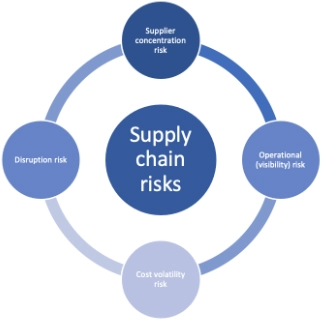
Let’s break it down into the key types that keep procurement leaders up at night.
- First, there is supplier concentration risk, that classic trap of overreliance on one or two vendors. In practice, it is like putting all your eggs in one basket, only to watch the basket get hit by a geopolitical storm or a factory shutdown.
- Then, operational risk rears its head: a lack of visibility into supplier performance or compliance. Without real insight, you are flying blind, hoping your vendors are as good as they claim.
- Cost volatility, where pricing shocks hit hard because your negotiation power is limited. A sudden spike in raw materials, and you are left footing the bill without leverage.
- Finally, disruption risk, the inability to pivot quickly during shortages or transportation issues. One port closure or a cyberattack on a key supplier, and your entire operation grinds to a halt.
This is especially relevant for mid-market organizations that often do not have the procurement scale to diversify or negotiate backup suppliers on their own. Without the buying power of a Fortune 500 giant, these businesses are more exposed to disruption. The good news is that this is where a strategic partnership with a GPO can flip the script.
How a GPO Partnership Reduces Supply Chain Risk
A GPO is primarily a cost-cutter, but also a risk-reducer in disguise because it provides access to a broad, vetted supplier network.
Una’s supplier portfolio, for example, gives members instant access to hundreds of pre-qualified, reliable vendors across multiple categories. This reduces dependency on a single supplier or region, with an easy, fast connection process to fill gaps or replace items during shortages. No more scrambling when your go-to vendor hits a snag.
Then there is the power of leveraged relationships that ensure priority service. Suppliers are motivated to prioritize GPO members during shortages or capacity crunches. We facilitate relationships with supplier account reps so Una members are treated like a "national account" in the supplier's eyes. The “power of many” helps maintain continuity when direct buyers might face stockouts or de-prioritization.
Finally, speed and agility in response to disruption set GPOs apart. If a supply line falters, Una’s members can pivot fast. Access to alternative suppliers and categories is already built into the membership with rapid access to 2,500+ pre-negotiated contracts. Activation takes days or weeks, not months..
How Una Turns Risk into Resilience
Our team maintains active communication with suppliers and members, flagging potential issues early. We are not passive middlemen. We are proactive partners, spotting trouble before it hits.
Our category expertise shines here, too. Una’s sourcing experts help members assess exposure, identifying where you might be over-reliant or vulnerable.
And with no-cost membership, it is easy for members to diversify their supplier base without financial barriers. There are no upfront fees or lock-in contracts; just immediate access to a robust network that bolsters your defenses.
Above all, it is our partnership mindset that sets us apart. Una acts as an extension of your procurement team. We collaborate, advise, and adapt to de-risk your supply chain.
We do not just connect you to suppliers. We connect you to stability. In the end, that is the real GPO advantage: we create one resilient partnership at a time.
Ready to lower supply chain risks, save more money, and earn time back? Join now or book a no-obligation discovery call to learn how group purchasing can work for you.