

TL;DR
- Use a GPO for high-commoditization indirect categories like office supplies, shipping, and facilities; individual RFP negotiations for these categories typically produce worse pricing than GPO collective buying power
- Use an RFP for core direct spend, deeply integrated operational dependencies, or categories where your organization's individual volume is large enough to command its own market leverage
- A GPO delivers pre-negotiated contracts with 18–22% savings immediately; no specs to write, no bids to manage, no months-long sourcing cycle
- Think of sourcing like a portfolio: use a GPO as your index fund for standardized indirect categories, and reserve RFP effort for the high-impact strategic categories that drive competitive advantage
- Una's collective buying power exceeds $100 billion — individual organizations cannot replicate that leverage through standalone RFP negotiations for common indirect goods
Procurement pros love a good process. There’s a comforting sense of security in running a textbook Request for Proposal (RFP) that checks the compliance boxes, satisfies the auditors, and feels like due diligence.
But running a full-blown RFP for every single category is a recipe for strategic burnout.
The traditional "three-bids-and-a-buy" framework carries a hidden tax: time. When you have a lean team and dozens of categories to manage, treating the RFP as your only tool means you are constantly playing catch-up.
Belonging to a group purchasing organization (GPO) provides an alternative (and faster) route to savings. But should you use a GPO every time?
The Choice of GPO vs. RFP
Before looking at when to deploy each strategy, let’s review the choice:
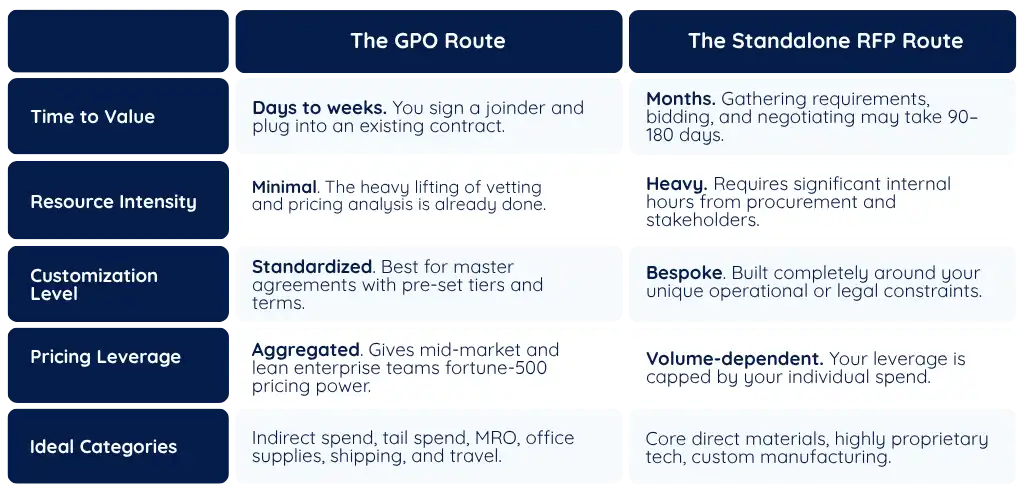
- The GPO Route: You are skipping the negotiation line. By joining forces with thousands of other companies, you leverage collective buying power (in Una's case, over $100 billion) to instantly access pre-vetted suppliers and heavily discounted contracts.
- The RFP Route: You write the specs from scratch, issue the bid, manage the supplier communication, score the responses, and negotiate bespoke Service Level Agreements (SLAs) tailored to your organization's unique footprint.
Decision Matrix
Use this baseline matrix to determine your path forward.
Scenario A: When the GPO is a Slam Dunk
A GPO is the clear winner in three specific scenarios:
1. High-Commoditization, High-Standardization
Indirect goods and services like office supplies, facility maintenance (Jan/San), or shipping are prime for a GPO engagement. Because the specs are highly standardized across all industries, a GPO has already maximized the pricing leverage.
Running a standalone RFP for these categories usually means your team spends months of labor just to land on a contract with higher unit pricing than the GPO. Why? Because your individual volume cannot compete with the aggregated, multi-billion-dollar buying power the GPO already brought to the negotiating table.
In other words, you are spending internal resources to get a worse result.
2. Lean Team
If you have three procurement pros attempting to manage dozens of spend categories, you physically can’t hope to run as many RFPs as you would hope to. Using a GPO enables you to outsource the administrative burden of indirect categories so your lean team can focus on the business-critical projects.
3. Immediate Speed-to-Savings
When leadership demands budget reductions this quarter, you don't have the luxury of a 6-month sourcing cycle. A GPO allows you to access a pre-negotiated contract and start capturing savings on day one.
Real-World Impact: Turning Shipping into Six-Figure Savings
A digital healthcare and manufacturing company were struggling to contain rising logistics costs but lacked the internal resource bandwidth to run an exhaustive, multi-carrier shipping RFP from scratch.
By bypassing the traditional sourcing event and plugging directly into Una's pre-negotiated shipping portfolio, they avoided months of administrative overhead. They unlocked six-figure savings on shipping costs almost immediately, delivering bottom-line relief without sacrificing months of internal team capacity to a complex logistics bid.
Scenario B: When You Absolutely Must Run an RFP
A GPO is a powerful lever, but it isn’t a magic wand. There are times when running your own ground-up sourcing event is non-negotiable:
1. Core Direct Spend
If you manufacture electric vehicles, you should never buy your lithium batteries through a generic catalog. Your direct spend (the raw materials and proprietary components that make your end product unique) requires deep, strategic relationships, custom quality control metrics, and highly tailored supply chain risk mitigation. This is where your team should spend three months running a flawless RFP.
2. Deeply Integrated Operational Dependencies
If a supplier needs to embed their staff into your physical facilities, integrate directly with a proprietary, custom-built ERP system, or follow highly irregular, state-specific legal compliance structures, a standardized contract probably won't cut it. You need a custom RFP to iron out those hyper-specific SLAs.
3. Monopsony Power (You Are the Big Fish)
If your organization's individual spend in a specific niche category is so massive that you command a significant percentage of the entire market's volume, a GPO's collective scale might not offer you additional leverage. In those rare instances, your individual footprint is large enough to bend suppliers to your specific will through a standalone event.
Take A Portfolio Approach to Sourcing
Remember, “busyness” is not the mark of an effective procurement team. No CPO has ever won an award for running more RFPs per year than their peers.
Think of sourcing like managing an investment portfolio. You don't hand-pick every single stock in your retirement account from scratch; you use index funds for the broad, standardized markets so you can spend your time researching the high-impact investments.
Using a GPO for your indirect and tail spend is your index fund. It clears out the noise, secures an immediate 18% to 22% savings benchmark, and frees your team to focus 100% of their energy on the must-have RFPs that drive your company’s competitive advantage.
Stop Running RFPs for Categories You Could Outsource Today
You don't need to commit to a massive operational overhaul to start optimizing your sourcing mix. The easiest way to protect your team's bandwidth is to identify just one or two indirect categories currently sitting on your Q3 schedule and see how your current pricing stacks up against billions in collective buying power.
- See the numbers firsthand: Plug your annual estimates into Una’s free cost savings calculator tool to see an immediate projection of your savings potential.
- Request a complimentary spend analysis: Let our sourcing advisors map your current supplier data directly against our portfolio of 2,500+ pre-negotiated contracts to pinpoint exactly where you can bypass the RFP process entirely.
Slash the RFP burden by exploring Una membership today. It’s completely free to join with no purchasing obligations.


