The digital procurement narrative has centered on automation for years. The goal was straightforward: teams identified a repetitive manual task and used technology to minimize or eliminate human involvement. Organizations automated invoice processing, digitized spend data, and deployed basic bots to handle the heavy lifting of the procure to pay cycle.
However, a limitation is becoming clear as we enter the era of agentic AI. Automation solves for the task, but It rarely solves for the process. It creates isolated pockets of efficiency that do not necessarily communicate with one another.
To bridge this gap, a new role is emerging within leading procurement functions. These professionals are moving away from managing individual tools toward a discipline known as orchestration.
Automation vs Orchestration in Procurement
Let’s start by distinguishing between automation and orchestration.
- Automation is about speed and consistency at a granular level. It uses technology to run defined tasks based on static rules. It is effective for activities with clear inputs and outputs such as approving an expense below a certain threshold or sending a notification when an order is placed.
- Orchestration takes a broader view. It manages and coordinates multiple automated processes across different systems to reach a larger business goal. Automation focuses on the individual task while orchestration focuses on the end to end workflow. It layers intelligence on top of isolated actions to ensure they occur in the correct sequence and adapt to changing conditions.
The Shift to Agentic AI
The catalyst for this shift is the evolution of artificial intelligence. We have moved beyond simple generative assistants that summarize text. We are now seeing the emergence of agentic AI.
Unlike standard automation which follows a rigid script, agentic systems are designed to act autonomously. They can use tools, navigate various software platforms, and collaborate with other agents to solve complex problems.
The procurement maturity model is shifting rapidly.
- Robotic Process Automation (RPA) involves fixed rule based task execution.
- AI Assistants provide on-demand help with specific queries.
- Agents act as autonomous entities capable of making decisions within set parameters.
- Agentic Platforms act as ecosystems where specialized agents work together to manage entire workstreams.
The Orchestration Professional is the human architect of this ecosystem. Their job is to design the logic, set the guardrails, and manage the interactions between these various digital entities.

Procurement Orchestration in Action
Many organizations begin their digital transformation by automating data entry in one department and scheduling in another. Without coordination, these efficiencies remain siloed. A disruption in one area of your supply chain requires immediate adjustments in inventory management, finance, and supplier communication.
A traditional automated system might flag a delay but fail to adjust the subsequent steps in the chain. Orchestration manages these complex processes by ensuring multiple specialized AI agents work in a synchronized sequence.
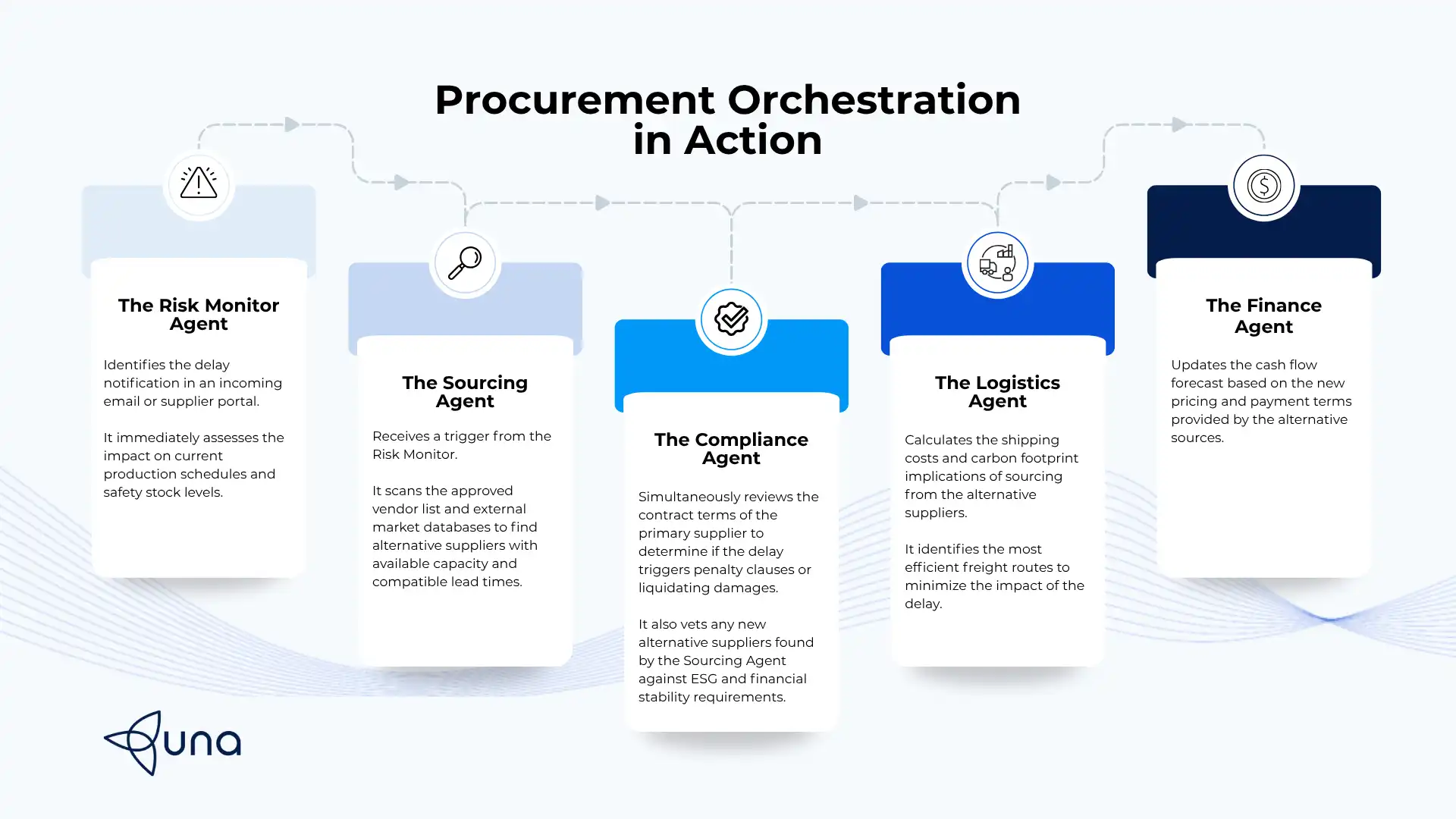
Consider a scenario where a primary supplier for a critical component issues a notice of a six-week production delay. In an orchestrated environment, the process moves through several autonomous agents.
- The Risk Monitor Agent identifies the delay notification in an incoming email or supplier portal. It immediately assesses the impact on current production schedules and safety stock levels.
- The Sourcing Agent receives a trigger from the Risk Monitor. It scans the approved vendor list and external market databases to find alternative suppliers with available capacity and compatible lead times.
- The Compliance Agent simultaneously reviews the contract terms of the primary supplier to determine if the delay triggers penalty clauses or liquidating damages. It also vets any new alternative suppliers found by the Sourcing Agent against ESG and financial stability requirements.
- The Logistics Agent calculates the shipping costs and carbon footprint implications of sourcing from the alternative suppliers. It identifies the most efficient freight routes to minimize the impact of the delay.
- The Finance Agent updates the cash flow forecast based on the new pricing and payment terms provided by the alternative sources.
The Procurement Orchestration Professional (that’s you) provides the oversight required for this ecosystem to function. They use centralized dashboards to track how these agents interact in real time.
This ensures that as agents make autonomous decisions, they remain compliant with company policy and broader strategic goals. The human intervenes only when an exception exceeds the pre-set guardrails, such as a significant price increase that requires human budget approval.
The New Skill Set: Systems Thinking
This shift requires a move toward a systems thinking mindset. The Orchestrator needs three primary competencies.
- Workflow Architecture: The ability to map cross-functional processes, understanding how data flows between finance, legal, IT, and external suppliers.
- Agent Governance: While the AI agents are autonomous, they require human-defined intent. The Orchestrator sets the objectives and the boundaries. This ensures the decision making logic of the AI aligns with the risk appetite of the organization.
- Dynamic Adaptation: Because business environments are volatile, orchestration introduces branching logic and exception handling that allows the system to reroute processes automatically when a supplier fails or a market price fluctuates.
The Automation of Automation
In short, orchestration is the automation of automation. It moves the profession from managing a patchwork of disconnected tools to overseeing a scalable and intelligent foundation.
In this environment, the most valuable employees will be those who can design and supervise the systems that execute the strategy.
Efficiency at the task level is now the baseline. The competitive advantage for future procurement teams will lie in their ability to coordinate those efficiencies into a cohesive and adaptive whole. The technology is already capable of doing the work. It is now up to the procurement professional to take the lead in orchestrating it.
Get in Touch
The shift toward orchestration means your plate is fuller than ever. As you move from managing tasks to designing complex agentic workflows, you need partners that reduce the manual burden of category management.
Join Una to reclaim your time and focus on the high-level strategy of your procurement ecosystem. As a leading Group Purchasing Organization, we provide the pre-negotiated contracts and deep supplier relationships you need to achieve immediate savings without the administrative heavy lifting.
Let us handle the foundational sourcing so you can focus on orchestrating the future of your function. Contact Una today.