

TL;DR
- Some salespeople assume that beating a GPO's price on an individual item makes the entire concept of group purchasing unnecessary.
- Procurement teams evaluate vendors based on overall operational efficiency and total cost savings rather than focusing strictly on line-item invoice discounts.
- Negotiating a one-off deal directly creates significant administrative burden through vendor vetting, legal contracting, and compliance checks.
- Using a GPO offloads routine indirect sourcing so internal purchasing teams can focus their limited time on high-value strategic priorities.
- A slightly lower direct price rarely sways a buyer if accepting it introduces extra organizational risk, implementation friction, and supplier management headaches.
I recently came across a complaint on Reddit from a salesperson who is clearly frustrated by prospects that use GBOs GPOs.
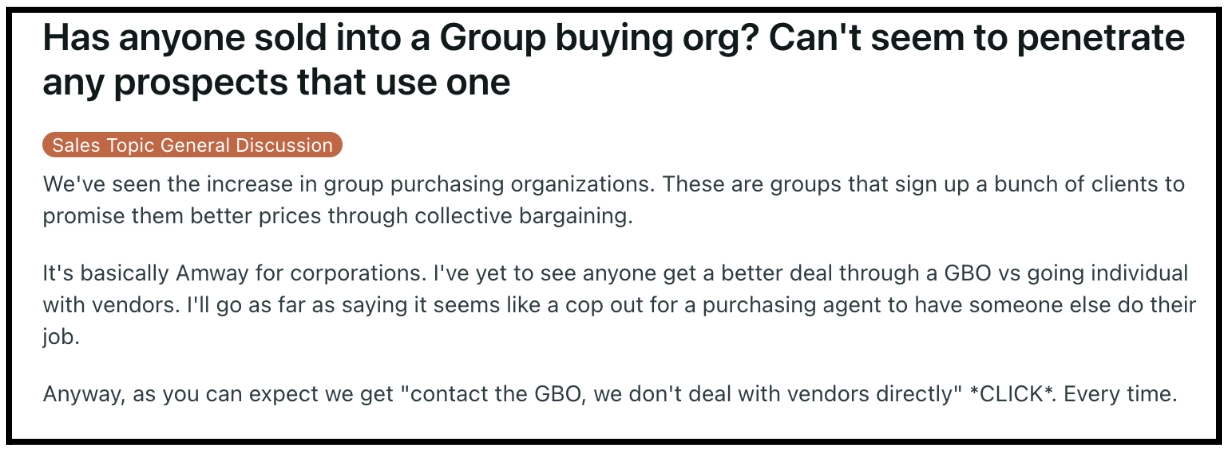
The argument was pretty simple. Group purchasing organizations sign up a bunch of companies, negotiate collectively with suppliers, and promise them better pricing. But, in the salesperson's experience, it should be possible for a purchasing manager to negotiate a better deal directly with a vendor. In fact, the salesperson goes as far as to suggest that relying on a GPO is something of a cop-out, because the purchasing team is effectively getting someone else to do its job.
All that aside, there is a legitimate question underneath the complaint: can an individual salesperson sometimes beat a GPO on price?
Yes. Of course they can.
In the right circumstances, a supplier can offer a customer a price that is lower than the price available through a GPO agreement. A salesperson may offer a loss leader to win the account, or the specific products being purchased may not represent a particularly strong fit for the GPO's negotiated pricing.
But what the Redditor isn’t taking into account is that the price on one purchase is only part of the equation.
A GPO is Doing More Than Negotiating a Lower Price
One of the problems with the salesperson's argument is that it assumes the main reason for using a GPO is to get the lowest possible price from a supplier.
Cost savings are certainly important, but GPOs also help organizations slash the time and effort spent sourcing suppliers, negotiating contracts, managing fragmented spend and dealing with purchasing processes across multiple locations or departments. In many cases, the appeal is as much about simplifying procurement as it is about finding cost savings.
This matters because procurement teams are rarely judged on whether they got the absolute lowest price on a single transaction. They are trying to manage spend across the organization.
A procurement manager might save another 5% by sourcing a product independently, but doing so requires a new supplier to be identified, assessed, negotiated with, contracted and then managed. There may be legal work involved, insurance documentation, compliance checks, onboarding, payment setup and all the internal approvals that come with introducing another vendor.
Perhaps the deal is still worthwhile. Perhaps it isn't. The point is that a GPO changes the calculation because the procurement team is buying into a broader commercial framework rather than starting from scratch every time.
What Was the Salesperson Selling?
The salesperson's frustration might make perfect sense if they were selling something highly specialized, strategically important or genuinely differentiated. A GPO agreement may not provide everything a particular customer needs, and there will always be categories where specialist suppliers can create significant value outside an existing program.
But what if this salesperson was working in an indirect category?
Indirect procurement often involves a huge volume of goods and services that are essential to keeping an organization running but are not themselves part of the product or service the organization sells. Think office supplies, facilities services, shipping, uniforms, maintenance, food, workplace products and plenty of other categories that can generate a surprisingly large administrative burden.
This high-volume area is where a GPO like Una shines by leveraging our $100 billion in collective buying power.

There is a Bigger Picture
The salesperson's comment also assumes that procurement is comparing one supplier against one GPO contract.
Large organizations rarely work that way. A procurement team may be managing hundreds of suppliers, thousands of transactions, multiple locations and a long list of internal stakeholders who all want something slightly different. There is a cost associated with keeping all of that moving.
A GPO can provide access to negotiated agreements across those purchasing activities and, in some cases, reduce the need for every individual business unit to negotiate separately. That creates value even when a particular supplier could offer a lower price through a one-off negotiation.
This is one of the reasons procurement discussions about savings can become misleading when they focus too heavily on individual line items. Saving $10 on a box of supplies is easy to understand, but saving hundreds of hours of procurement time, reducing the number of suppliers that need to be managed, improving compliance and giving employees a straightforward way to buy approved products is more valuable.
New Suppliers Need Vetting
The salesperson is also overlooking something that becomes very important once a company has a mature procurement function: buying from a new supplier creates work.
Procurement teams need to know who they are dealing with. They may have to assess financial stability, insurance, contractual terms, compliance requirements, security standards and other organizational requirements before they can approve a supplier.
A GPO can help simplify some of that because the organization is buying through an established program with pre-negotiated agreements and approved (vetted) suppliers. Procurement compliance is one of the areas where GPOs can create value beyond the price paid for a product.
Procurement Has Limited Time
There is also a slightly uncomfortable assumption in the original complaint, which is that purchasing managers have all the time in the world to negotiate with every salesperson that knocks on their door.
They don't. Procurement teams are under pressure to reduce costs, manage risk, support internal stakeholders, improve supplier relationships and contribute to broader business objectives. At the same time, they are often trying to do this with finite resources.
That is one reason GPO membership is so attractive. It enables your team to focus its internal resources where they are most valuable, while someone else handles elements of the sourcing process.
Where Salespeople Sometimes Misread Procurement
There is a belief in sales that if you can demonstrate enough value and offer a compelling enough price, the buyer should be willing to switch.
Procurement is usually thinking about something broader:
- What does this supplier mean for the total category?
- What are the risks?
- How difficult will implementation be?
- What happens across the rest of the business?
- Will this improve the overall procurement strategy or just create another exception?
To give the salesperson some credit, they are right about one thing. A direct negotiation can sometimes beat a GPO on price. The mistake is assuming that this makes the GPO unnecessary.
A GPO is solving a broader procurement problem. It can combine purchasing power with supplier access, contractual arrangements, compliance and process efficiency, which means the customer is evaluating much more than the price on a single invoice.
If your only advantage is that you can offer a lower price than the GPO, you may have a difficult time breaking in.
Do More With the Power of Group Purchasing
Save money, simplify procurement, and feel empowered. Una works to optimize your procurement strategy, laying the foundation for increased cost savings and better overall spend management. Learn more.


