TL;DR
- A single GPO will not always serve every category, and using several can work well when each one has different category strengths.
- Multiple GPOs only work if none of them imposes exclusivity, lock-ins or minimum purchase requirements.
- Fees matter, because memberships and other charges from each GPO can pile up and cancel out your savings
- Una is free to join with no lock-ins, so it sits comfortably alongside other GPOs.
- Before adding a second GPO, compare the terms and total fees, and let your categories decide.
So, you’re seeing other GPOs? We’re okay with that. Really!
Plenty of procurement teams wonder whether a single Group Purchasing Organization should carry all of their indirect spend, and the honest answer is that it depends on the category, the contract terms and what (if anything) each GPO charges you.
This article explores where a multiple GPO strategy works, where it falls apart and where we can and cannot help.
Vertical vs Horizontal GPOs
Let’s start with the two basic models: vertical and horizontal GPOs.
- Vertical GPOs serve a single industry, such as healthcare, hospitality or dental, and they build their contracts around what that industry buys most.
- Horizontal GPOs (which include Una), serve organizations in every market and cover a broad spectrum of goods and services, mostly in indirect spend.
A vertical GPO can go deep on the specialized supplies your sector depends on, while a horizontal GPO gives you breadth across the categories that every business shares.
So, it makes sense for some organizations to join one of each. For example, a medical center might use a vertical GPO for specialist equipment, and a horizontal GPO like Una for the everyday categories that just about every business buys, such as office supplies, shipping and food service.
The medical center's vertical GPO might offer to look after its indirect category spend as well, but its contracts and expertise are built around clinical purchasing, so indirect categories tend to be a smaller part of its portfolio.
A horizontal GPO like Una concentrates on those categories and pools the volume of members from every market, so the medical center gets deep sector expertise from one GPO and a stronger indirect portfolio from the other.
Horizontal GPOs Have Different Strengths
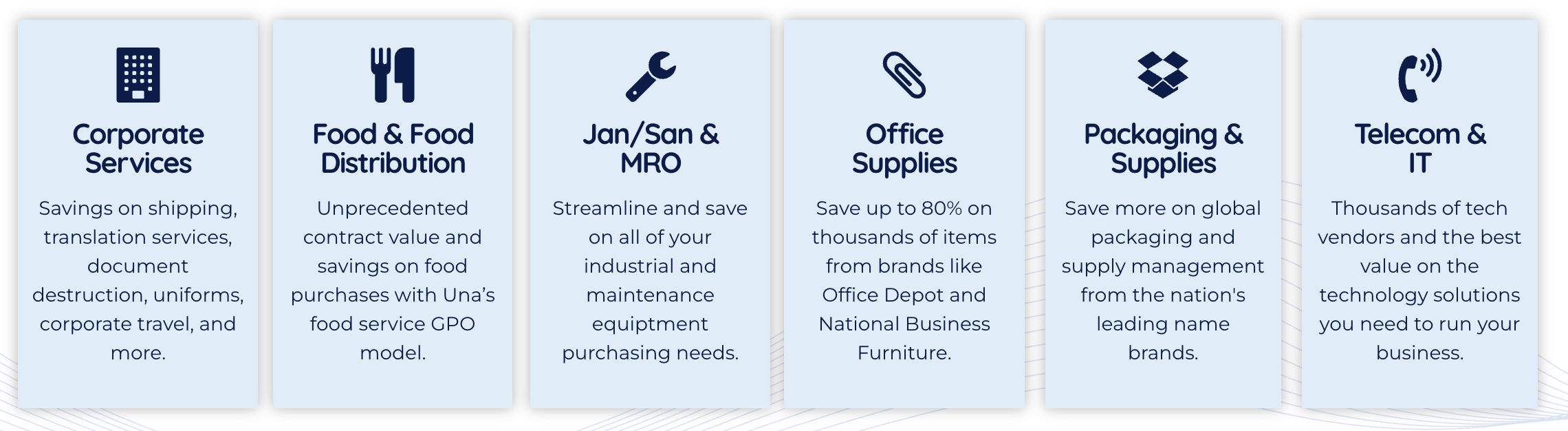
Even among horizontal GPOs, no two portfolios look alike, because each one has built its buying power in different places. Una is proud of what our members' combined volume achieves in shipping, where members have saved more than 23%, in food distribution, where savings have topped 20%, in office supplies, where contracts reach up to 80% off list price, and in technology, where members save between 20% and 30% through thousands of vendors.
Across more than 2,500 contracts, our members save an average of 18% to 22%.
Another GPO may hold a stronger contract in a category where our portfolio is thinner, and if that happens, using both makes good sense. A GPO may not offer every product a member needs, which can mean buying some items outside the contract. Filling those gaps through a second GPO is a reasonable solution, provided the terms allow it.
Where Multiple GPO Strategies Would Not Work
Running several GPOs only works when every one of them leaves you free to buy wherever the value is best. This is where Una's “no lock ins and no obligation” approach makes a real difference. We never require members to buy from particular suppliers or commit to a purchase volume, and you can use one supplier agreement or many, as much or as little as you like. If every GPO you join works this way, you can take the best contract in each category without penalty.
Trouble starts when another GPO does things differently, so look out for exclusivity clauses, lock in periods, minimum purchase requirements and cancellation fees. An exclusivity clause on food purchasing, for instance, may put you in breach the moment you buy through a second GPO, while a minimum volume commitment can force you to steer spend toward a GPO you would rather bypass. Read the contract terms of each GPO before you sign, because a single restrictive agreement can undo the flexibility that the others give you.
Fees Add Up Quickly
Una is completely free to members. We never charge a membership fee, because supplier administration fees cover our costs, and suppliers are glad to pay them in return for the added volume.
But some GPOs pass costs on to members through memberships or other charges, and that changes the arithmetic of a multiple GPO strategy considerably. One membership fee might be easy to justify against the savings you receive, but two or three of them can eat into those savings before your first order ships. If you are weighing up a second or third GPO, add up every fee first and compare the total against the savings you expect in the categories you plan to buy through each one.
When a GPO Uses a GPO
Sometimes the best evidence that one GPO cannot cover everything comes from another GPO.
YPurchasing is a group purchasing organization serving YMCAs across the United States, so its leadership team already understood the power of collective buying. Food was an important category for its members, and YPurchasing wanted to carve out additional savings there, so it added Una’s food contracts to its own portfolio. The result was an extra 10% to 15% savings on food costs for YMCAs, whose members could reach Una's contracts free of charge, with no long term commitments and no product limitations.
How to Decide
A sensible way to decide is to map your spend by category, identify where each GPO you are considering has its strongest contracts and then check the terms and fees before you commit to anything.
Where the terms are clean and the fees are zero, the case for multiple GPOs is strong. Where exclusivity, minimums or memberships come with the deal, a single GPO, or a carefully chosen pair, will usually serve you better. At Una, our sourcing advisors will compare your current spend against our contracts before you commit to anything, and if that comparison shows another GPO would serve a category better, we want you to know.
For a structured way to compare your options, use our free framework which sets out the questions to ask about model fit, category coverage, contract flexibility and more.
Ready to start using a GPO to save more money, time and effort? Contact the Una team today.