
Your Guide to Proactive Procurement
Shifting from reactive buying to value creation.
How to transform procurement from a reactive function into a proactive force that drives business success.
- Procurement must shift from reactive to proactive - it's time to move from handling requests to anticipating needs and creating strategic value.
- AI is making reactive work obsolete. Human value now lies in strategy, creativity, and foresight.
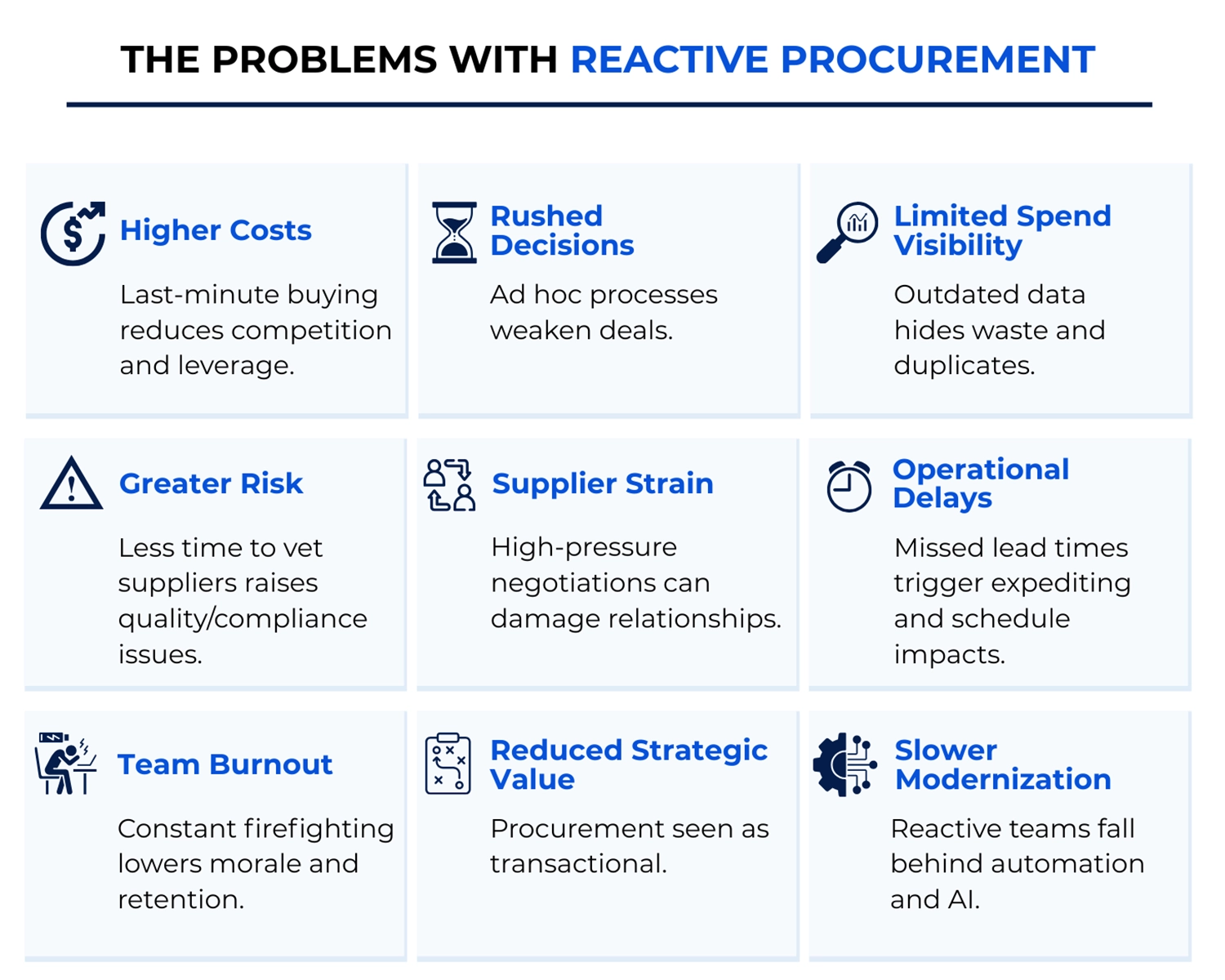
- Reactive procurement is costly and limiting. It leads to higher costs, rushed decisions, poor visibility, and low strategic impact.
- Proactive procurement drives real business impact. It enables cost savings, risk reduction, innovation, and stronger cross-functional alignment.
- The role of procurement is evolving into a strategic partner.
- A successful shift requires data, technology, new skill sets, and external partners (like GPOs) to free up time for strategy.
From Reactive Buying to Strategic Value Creation
Procurement teams often find themselves caught in the daily grind, handling never-ending requests, negotiating deals on the fly, and ensuring supplies keep flowing.
Admittedly, procurement has long been viewed as a support function, essential but not always central to strategic decisions.
Thankfully, that perspective is changing and we’re realizing there is a better way.
Shifting to proactive procurement positions you as a key player in cost management, risk reduction, and innovation.
This guide outlines the shift from reactive to proactive approaches. We'll examine the limitations of traditional methods, explore what proactive procurement entails, and provide practical steps to make the transition.
By the end, we'll demonstrate that one of the most effective proactive steps you can take is to reach out and join a group purchasing organization (GPO), a move that amplifies your efforts without requiring you to reinvent the wheel.
Proactive Procurement is Vital
...for your career and the profession!
This is no time to sit back and wait to see what happens.
AI tools are already automating routine tasks. If your role is limited to reacting to "buy" signals (approving requisitions, sourcing suppliers in a hurry, and analyzing basic spend data), it's increasingly at risk.
AI excels at these repetitive, rule-based activities. It can scan markets for prices, generate reports, and predict simple demand patterns faster and more accurately than humans in many cases.
But here's where humans maintain a clear advantage, at least for now: in proactive, innovative thinking. This involves anticipating needs before they arise, forging creative partnerships, and solving complex problems that require empathy, negotiation, and out-of-the-box strategies.
Proactive procurement means creating value that AI can't replicate easily: things like spotting untapped opportunities in supply chains.
Become Vital.
Embracing proactivity will help make you indispensable. Reactive buyers might handle the day-to-day, but proactive professionals influence strategy, collaborate across departments, and deliver an entirely different level of impact.
This elevates your role from cost controller to business partner, opening doors to leadership positions (and greater job security).
On a broader scale, the survival of the procurement profession depends on this shift. If you think this sounds a bit alarmist, take a moment to check out the current state of procurement AI (particularly agentic AI), which is moving fast to automate every routine task in the profession.
If the field remains synonymous with transactional work, it could be largely automated, much like how AI has transformed data entry or basic accounting. But by focusing on proactive, innovative strategies, like developing resilient supply networks or leveraging emerging technologies for ethical sourcing, procurement can evolve into a strategic discipline.
Organizations that invest in proactive teams see reduced costs, improved compliance, and enhanced agility in volatile markets. Ultimately, it's essential for staying relevant, safeguarding your career, and helping redefine procurement as a vital, forward-thinking function.
What's Holding You Back From Becoming Proactive?
Shifting to proactive procurement? Easier said than done. Recognizing the barriers that stand in the way is the first step toward overcoming them.
Organizational Structure
In many companies, procurement is siloed, with limited access to other departments. This isolation makes it hard to anticipate needs or collaborate on solutions. If your team is buried under administrative tasks, there's little bandwidth for strategic thinking.
Resource Constraints
Tight budgets and understaffed teams force a focus on immediate fires rather than long-term, proactive planning. Without tools like analytics software, gathering insights feels overwhelming, leading to a cycle of reaction.
Cultural Resistance
Stakeholders might view procurement as a mere order-fulfiller, not a strategic advisor. Efforts to change the function can fizzle out if leadership doesn'tchampion proactive initiatives.
Personal Factors
If team members lack training in the skills that make it possible to get proactive they may default to familiar, reactive habits.
External Pressures
Things like supply chain disruptions or economic uncertainty can make proactivity seem like a luxury, when in reality, it's more important than ever.
Addressing these barriers requires intentional effort, from advocating for better tools to building cross-functional relationships. The good news is that small changes can yield big results, setting the stage for a more proactive approach!
The Reactive Procurement Trap
Reactive procurement (or we could call it “default mode”) is fraught with challenges that limit the function’s effectiveness.
At its core, this approach involves waiting for a "buy" signal from the business, then scrambling to fulfill it.
While it keeps operations running, it comes at a high cost.
What Proactive Procurement Looks Like
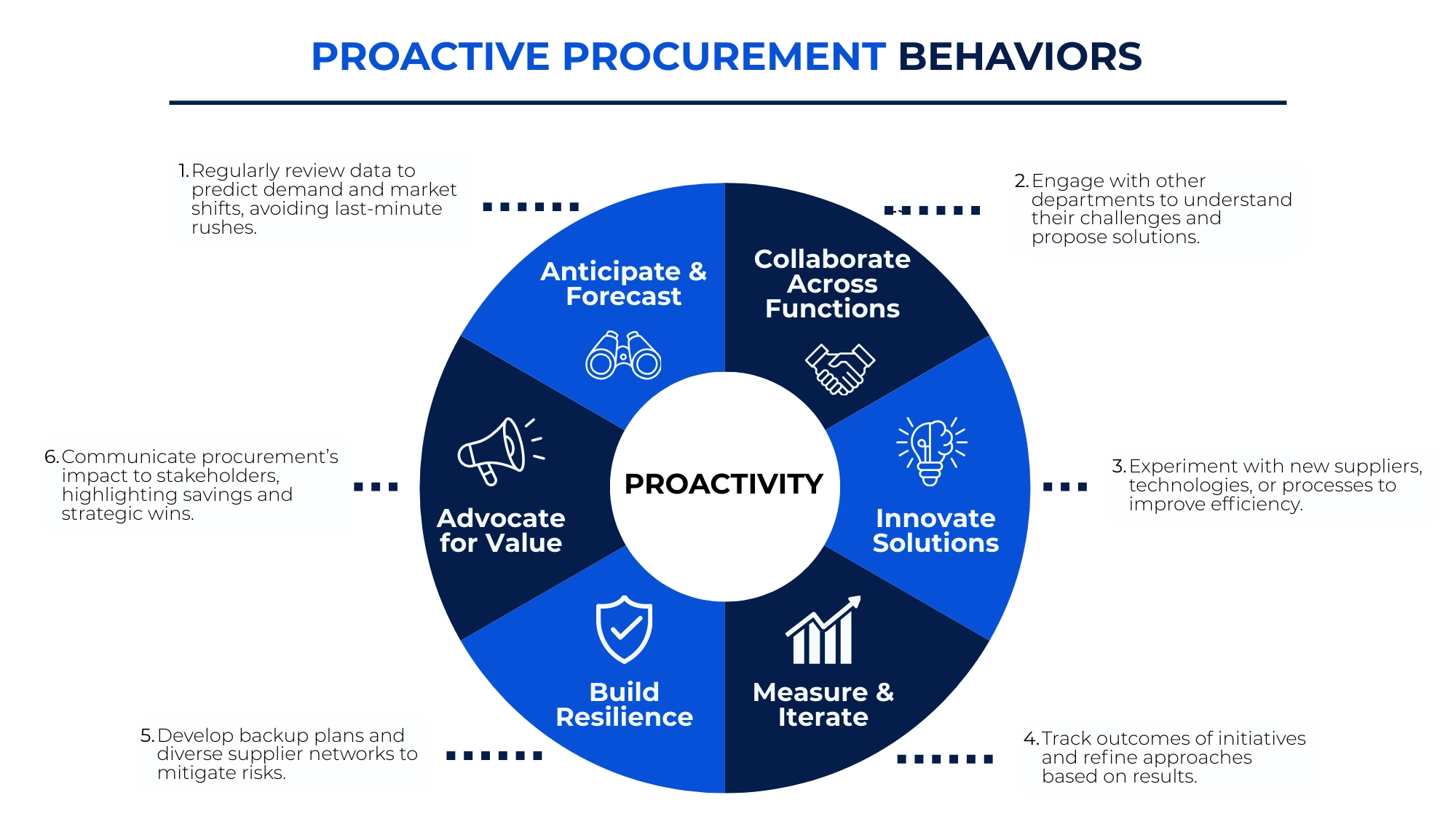
Proactive procurement flips the script.
It means focusing on anticipation, strategy, and value creation rather than mere response. It involves using insights to predict needs, optimize processes, and align with broader business objectives. Suddenly, costs come down, while resilience and innovation go up.
At its heart, proactive procurement means building systems that prevent problems. Instead of waiting for a supply shortage, for example, you analyze market trends to secure contracts ahead of time.
It emphasizes collaboration, where procurement works hand-in-hand with finance, operations, and other functions to identify efficiencies.
 Download the Guide
Reimagining the Procurement Team
Reimagine procurement not as a fixed department, but as agile internal consultants who move seamlessly across functions, get to know stakeholders’ pain points, then deliver targeted solutions.
Marketing
One of your teams might embed with marketing to audit event vendor contracts, consolidate suppliers and negotiate better rates on materials and services.
Operations
In operations, they could analyze equipment maintenance spend and propose predictive maintenance contracts that reduce downtime and lower costs.
Product Development
During product development, the team might spot early supply chain risks and recommend more sustainable, cost-effective alternative materials.
HR
With HR, they could optimize uniform and PPE sourcing by partnering with eco-friendly vendors that align with company values while cutting expenses.
Get it right, and the team will enjoy broader insight, stronger relationships, and a noticeable shift in tone from a support function to a strategic (and proactive!) partner.
Shifting to a Proactive Mindset
Transitioning to proactivity starts with your team. To hire proactive talent, look beyond traditional resumes.
Seek candidates with skills in analytics, problem-solving, and communication; perhaps from backgrounds in consulting or data science. During interviews, ask candidates about times they've anticipated issues or driven change, rather than just managed transactions.
For existing teams, encourage mindset shifts through workshops on design thinking or scenario planning. Set goals that reward proactive behaviors, such as leading cross-functional projects or identifying new savings opportunities.
Mentorship programs can pair reactive staff with proactive mentors, while performance metrics could emphasize outcomes like cost avoidance over order volume. Over time, this cultivates a team that's adaptable and innovative, ready to tackle complex challenges.


Proactive Procurement Toolkit
Apart from the right mindset, what’s in the proactive procurement professional’s toolkit? To go proactive, equip your team with the right tools.
Essential items include:
- Spend analytics software: Platforms for real-time data insights and forecasting.
- Supplier Relationship Management (SRM) systems: Tools to track performance and collaborate effectively.
- Market intelligence resources: Subscriptions to reports for trend monitoring.
- Collaboration platforms: Like Microsoft Teams or Slack for cross-departmental communication.
- AI and automation tools: For automating routines, freeing time for strategy.
- Training resources: Online courses on proactive skills (these don’t necessarily need to be procurement-focused).
- Partnerships: Partners like Una can help slash the burden of day-to-day, reactive procurement, allowing you to plan ahead.
The Best Proactive Move You Can Make
Get Proactive. Be Empowered.
From a proactive perspective, Una serves as a true extension of your team. Our sourcing experts continuously monitor suppliers for compliance, quality, and competitive pricing, freeing your staff from routine market research and negotiations.
This allows your professionals to operate as agile internal consultants, moving across functions to uncover pain points and deliver targeted solutions backed by Una's resources.
If, for example, your team identifies inefficiencies in food costs across locations, Una's contracts with major distributors can deliver instant savings of 15-20% or more, letting you concentrate on long-term supply chain resilience.

If your operations team spots fragmented MRO spend, this becomes an opportunity to implement Una-backed contracts that save money, time, and effort, while your team embeds elsewhere to drive broader value.
Una acts as a Sourcing Accelerator. Group purchasing eliminates common barriers by providing ready-to-use contracts and expertise, shrinking traditional sourcing timelines from months to weeks and reclaiming significant staff time for strategic, cross-functional impact.
Ready to get started?
Contact the Una team for a no-obligation discovery call to explore how Una can amplify your procurement goals and keep your organization thriving.