

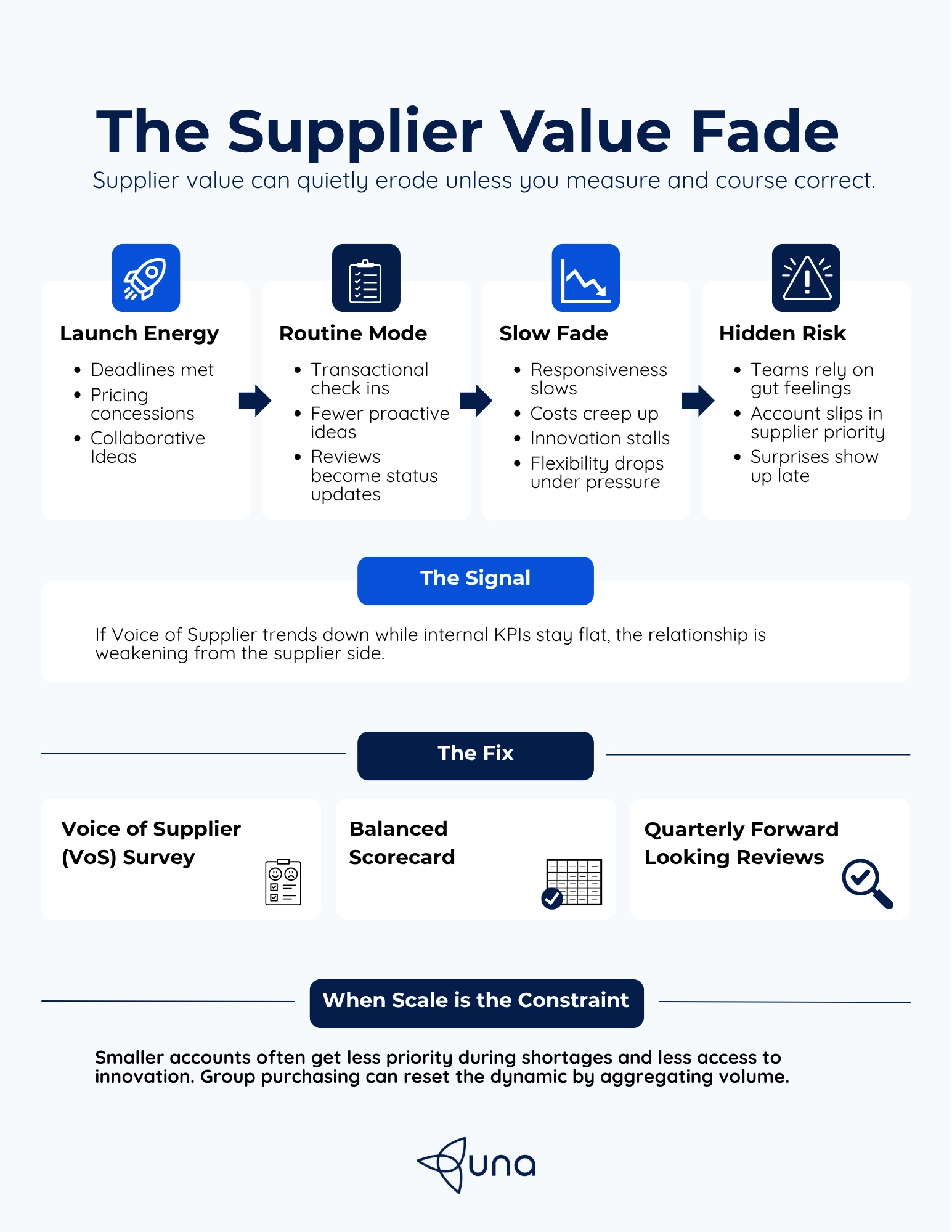
The partnership launched with energy. Tight deadlines met, pricing concessions secured, and collaborative ideas floated during early reviews. Months (or years) later, the conversations feel routine, the responsiveness a little slower, and the value delivered somehow less compelling.
You sense the relationship has shifted, but pinning down why, or by how much, is surprisingly difficult.
Everyone in procurement has felt it at some point: that quiet uncertainty about where exactly your company stands with a key supplier.
The Slow Fade of Supplier Value
This ambiguity is more common than many admit. Organizations invest heavily in supplier relationship management (SRM) programs expecting sustained returns, yet too often watch ROI erode without a clear diagnosis. Initial wins give way to steady-state performance that fails to evolve. Costs creep up, innovation stalls, and flexibility disappears at the first sign of market pressure.
The frustrating part is the apparent lack of reliable ways to measure and course-correct the relationship.
Without structured assessment, procurement teams operate on instinct and anecdote. “They seem responsive” or “We’ve always had a good rapport” becomes the default gauge. These impressions might feel accurate in the moment, yet they rarely capture the full picture. Suppliers juggle dozens or hundreds of customers. Your account might have slipped from “strategic” to “maintenance” status without anyone saying so aloud.
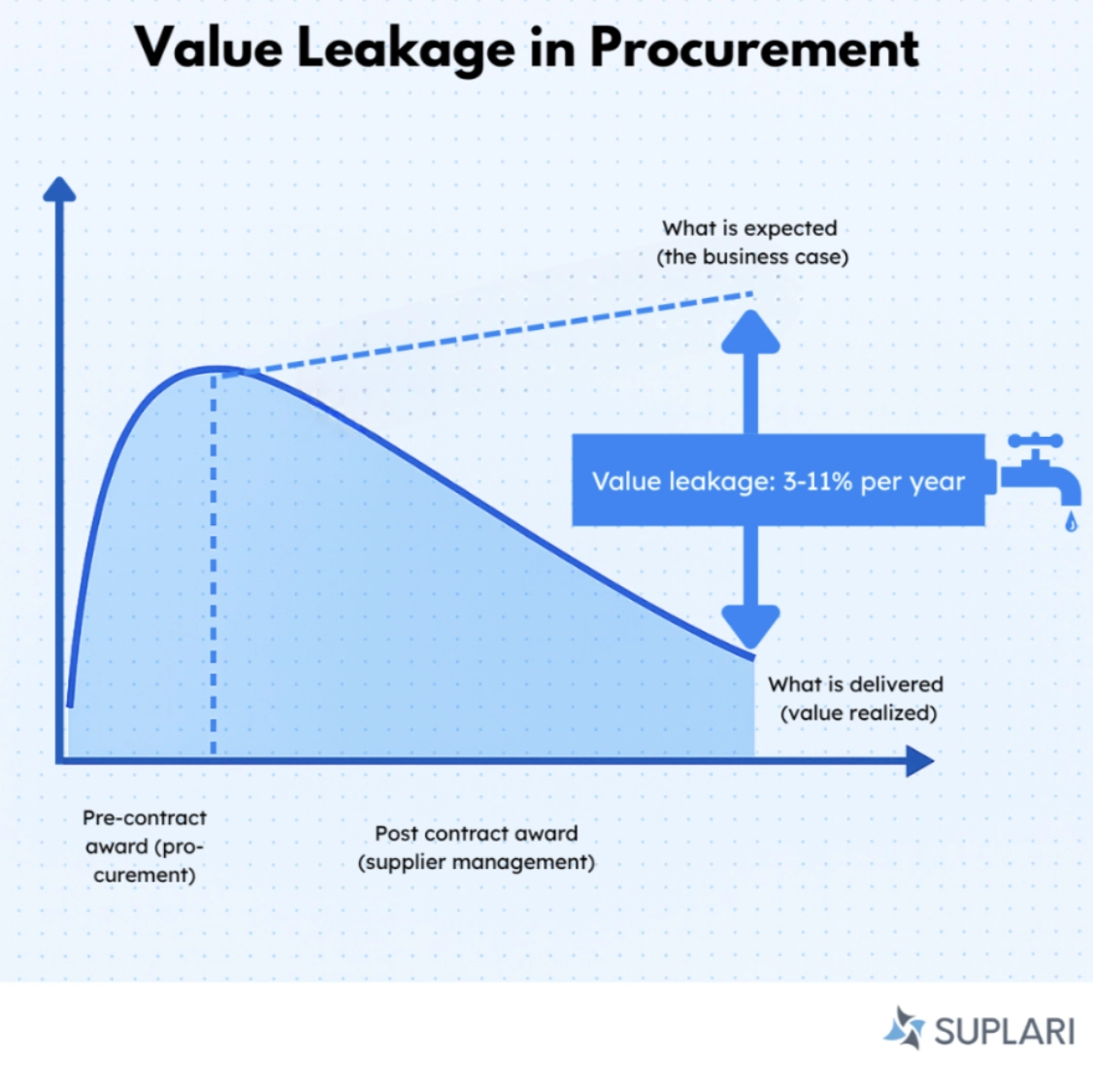
Meanwhile, internal stakeholders assume the relationship remains strong because deliveries still arrive and invoices get paid. How much value is lost? Suplari.com suggests as much as 3% to 11% per year.
Moving Beyond a Gut Feeling
The good news is that assessing relationship strength is both possible and practical. It starts with moving beyond one-sided scorecards that only track supplier performance and incorporating the supplier’s perspective on you as a customer. Voice of Supplier (VoS) surveys represent one of the most direct and illuminating tools available.
A well-designed VoS survey asks suppliers to rate your organization across the dimensions that matter most to them: payment timeliness, forecast accuracy, ease of doing business, willingness to collaborate on cost reduction or product improvement, and overall strategic alignment.
Questions should be specific enough to yield actionable data yet broad enough to reveal patterns. For example, “On a scale of 1–10, how predictable are our volume commitments?” or “How would you describe the level of collaboration when we face supply disruptions?” Consider sending out these surveys annually or biannually, ideally through a neutral third party to encourage honest answers, and track trends over time (rather than isolated snapshots).
The insights can be surprising. A manufacturer might discover its suppliers view payment terms as punitive compared with industry norms, eroding goodwill that once translated into priority allocation during shortages. A service provider could learn that last-minute specification changes (once tolerated in the honeymoon phase) are now driving hidden costs and resentment.
When VoS scores trend downward while internal KPIs remain flat, the data signals that the relationship is weakening from the supplier’s side, even if deliveries continue uninterrupted.

Building a Balanced Assessment Framework
VoS is powerful, but it works best as part of a broader assessment framework:
- Complement it with balanced relationship scorecards that blend quantitative and qualitative metrics.
- Track traditional supplier performance indicators (on-time delivery, quality defect rates, cost savings delivered).
- Track relational health markers: frequency and depth of joint planning sessions, number of supplier-initiated improvement proposals, speed of escalation resolution, and evidence of shared risk during volatility.
- Some organizations assign weighted scores across categories (commercial, operational, strategic, and innovation) and calculate an overall “relationship equity” index.
Reviewing these quarterly with cross-functional stakeholders prevents any single perspective from dominating the narrative.
Regular partnership reviews remain important, provided they evolve beyond status updates. Transform them into forward-looking forums where both parties examine mutual value creation.
Ask:
- What are we doing well together?
- Where are we leaving money or capability on the table?
- What external pressures could disrupt us, and how can we prepare jointly?
Document agreed-upon actions and revisit them at the next meeting. The presence or absence of proactive ideas from the supplier often reveals whether they view your business as worth the extra effort.
We’re Too Small for the Supplier to Care About Us
One underlying issue frequently caps relationship potential: scale. If your annual spend with a supplier represents a tiny fraction of their total business, they may quietly categorize your account as “small” or “tactical.” That designation carries real consequences. Larger customers receive priority during allocation crunches, first access to new product launches, more favorable payment terms, and dedicated account resources.
Your team might negotiate hard for discounts, yet the supplier’s internal economics simply do not justify treating you as strategic. The relationship plateaus, because the supplier’s attention and investment follow their largest revenue streams… which is understandable.
This dynamic explains why many mid-sized and smaller organizations experience the classic SRM paradox: strong initial engagement followed by gradual disengagement despite consistent performance.
Reset the Dynamic with Group Purchasing
Joining a group purchasing organization (GPO) like Una changes the equation. Instead of negotiating in isolation, your organization pools its purchasing volume with thousands of other members. That collective leverage transforms modest individual spend into a meaningful slice of an enormous, aggregated contract.
Suddenly, you become part of what the supplier views as one of its most significant accounts. The attention, flexibility, and strategic engagement that once seemed reserved for enterprise giants now extend to you.
How does it work? GPOs like Una maintain pre-negotiated master agreements with top-tier suppliers across indirect and direct categories. Members gain immediate access without the need for lengthy contract negotiations. Because Una leverages over $100 billion in combined purchasing power, suppliers allocate senior resources, faster response protocols, and continuous improvement programs to the member base.
Payment terms improve, innovation roadmaps open up, and risk mitigation becomes collaborative rather than reactive. The supplier relationship flips from “nice-to-have” to “must-protect,” because losing the GPO contract would impact a substantial revenue stream.
Procurement teams report measurable shifts after joining. The VoS scores that once trended sideways begin climbing as the relationship regains momentum.
None of this requires sacrificing control. Members retain autonomy over their purchasing decisions and can layer GPO contracts alongside existing strategic suppliers where appropriate. The GPO simply amplifies leverage without replacing internal expertise.
Ultimately, assessing supplier relationship strength is less about finding a perfect score and more about creating a continuous feedback loop that keeps value flowing in both directions. When that loop reveals limitations rooted in scale rather than execution, the smartest move could be to aggregate your purchasing power by joining a GPO.
Una has helped thousands of businesses unlock deeper savings, stronger supplier engagement, and measurable ROI improvement with zero membership fees.
Make your voice count at a volume suppliers cannot ignore. Join Una today.


