

Confession time: I had to look up the word disintermediated after I heard it mentioned at a recent procurement roundtable. My guess was that it was a fancy way to say you’ve been kicked out in the middle of a deal. Turns out, that was almost right.
In procurement, disintermediation is the process where business stakeholders skip the traditional middle players (that's us) and go straight to suppliers. Think of it like cutting out the travel agent and booking your flight directly on an airline's app. It's efficient, it's direct, and for the procurement function, it's an existential concern.
Let’s explore why this is procurement's biggest fear and, more importantly, how we can flip the script to stay relevant.
What’s Driving Disintermediation in Procurement?
At its core, disintermediation in procurement means bypassing the team that has historically handled sourcing, negotiating, and buying goods and services for an organization.
Driven by digital transformation, B2B e-commerce platforms, and the rise of supplier-direct portals, it's easier than ever for internal stakeholders to just hop online and purchase what they need without looping in procurement.
Sounds convenient, right?
But if procurement is seen as nothing more than a bureaucratic hurdle, disintermediation could make us irrelevant. Unless we adapt, that is. The key is to evolve from a gatekeeper role to something more dynamic, proving our value in ways that direct buying can't match.
Just Another Term for Maverick Spend?
At first glance, disintermediation and maverick spend might seem like two sides of the same coin. Both involve bypassing procurement to buy directly.
Yes, there's overlap: maverick spend often manifests as disintermediation in action, where rogue employees snag deals from unapproved suppliers, eroding procurement's control and visibility. It's the symptom of a deeper trend, fueled by digital ease, making "going direct" feel like a natural rebellion against bureaucracy.
But they're not synonymous. Disintermediation is a broader, systemic shift brought about by structural changes; B2B e-commerce and supplier-direct models that fundamentally challenge procurement's role. While maverick spend can accelerate disintermediation, the latter is the existential threat, and can only be solved with strategic adaptation rather than just policing spend. In short, one is the act; the other is the revolution.
Can You Articulate the Value?
If procurement is just the "middleperson," where's the genuine value?
Put it this way: if a stakeholder storms into your office (or, more likely, pings you on Teams) and asks, "Why shouldn't I just buy this software directly from the vendor? It's faster, and I can get it done today." Your knee-jerk response might be, "Because that's the rules!"
But that's not compelling. Can you articulate a rock-solid answer that goes beyond policy? If not, you're already on shaky ground. The value lies in expertise and skills that direct buyers often overlook in their rush for speed, like negotiating volume discounts, understanding and ensuring compliance, managing risks, and optimizing total costs.
Suppliers are stepping up their game with slick digital experiences, making it tempting for departments to bypass us entirely. The result? We lose our value-add, and suddenly, procurement feels like an unnecessary layer.

Losing Spend Visibility and Control
Consider the loss of spend visibility and control. When buyers go rogue, it creates blind spots. That fancy new gadget bought via a manufacturer's portal? It's off the books, meaning procurement can't track expenditures accurately.
This fragmentation weakens our negotiation power too. Imagine trying to haggle with a major supplier for volume discounts when half your organization's spend is scattered across unmanaged direct buys. You lose leverage, prices creep up, and the whole system gets chaotic.
Rising Operational Risks
Then there's the spike in operational risk and complexity. Disintermediation often means ditching trusted intermediaries who handle the boring-but-necessary jobs like quality checks, supplier vetting, and compliance.
Bypassing procurement inevitably means a sharp rise in the number of vendors on the books, and suddenly, procurement is on the hook for verifying thousands of new, direct suppliers, many unvetted and potentially shady.
The Hidden Costs of "Cheaper" Direct Buying
“But I’ve found a better deal!”
How often have you heard someone tell you this?
Direct buying might look cheaper on the surface, but zoom out to total cost of ownership (TCO), and the picture changes. Administrative burdens skyrocket: more invoices to process, fragmented relationships to manage, and logistics headaches that add up. Procurement staff, instead of focusing on strategic wins, get bogged down in cleanup duty. Those "savings" evaporate when you factor in the overhead.
The Shift in Internal Expectations
Finally, there's a shift in internal expectations that's reshaping the game. Business stakeholders are consumers, too, and they want an "Amazon-like" experience (seamless, fast, digital) for everything. If procurement sticks to slow, rigid processes, we're seen as the bottleneck slowing down progress. Why deal with us when you can go direct?
How to Show the Value
Alright, enough with the fear-mongering. The solution boils down to showing our value, adapting to the digital wave, and repositioning procurement as a service provider rather than a gatekeeper.
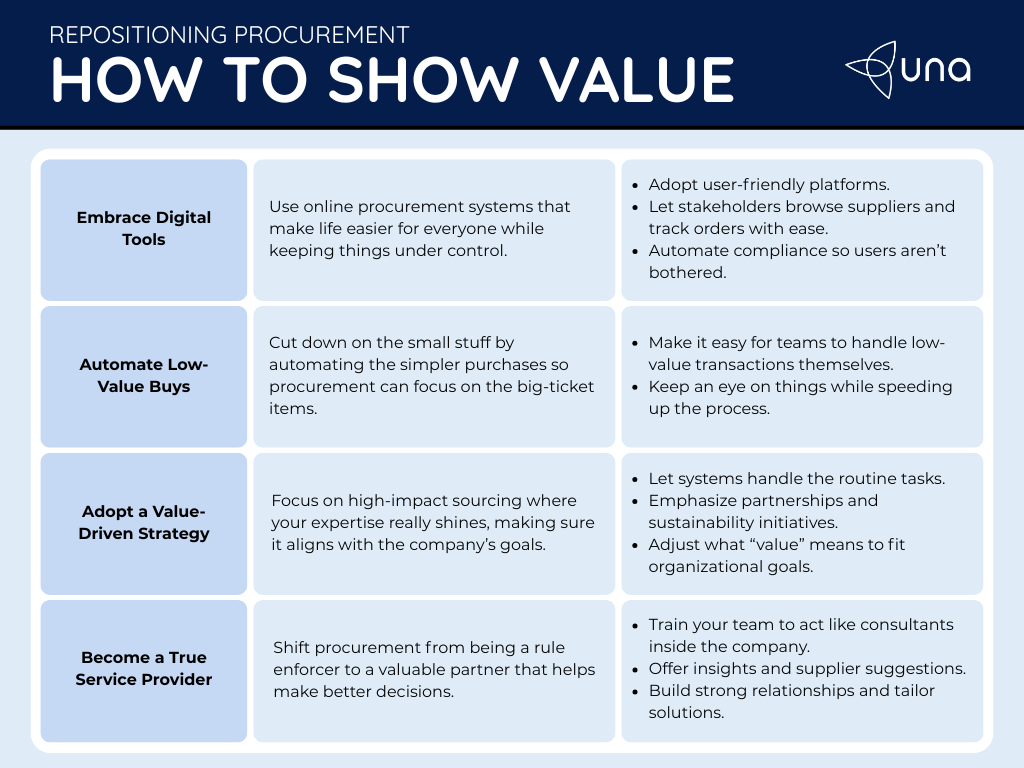
Embrace Digital Tools
Start by adopting digital tools. Implement e-procurement systems that offer ease of use while maintaining control. User-friendly platforms will allow stakeholders to browse approved suppliers, get instant approvals, and track orders without red tape. Compliance processes exist, but they’re happening automatically and invisibly in the back end, and not getting in the user’s way.
Automate low-value buys, freeing up procurement to get involved only in big-ticket items. Enable speed and self-service without sacrificing oversight.
Adopt a Value-Driven Strategy
Next, shift to a value-driven strategy. Focus on complex, high-value sourcing where your expertise shines: strategic supplier partnerships, strategic insights, sustainability initiatives, or risk assessments that direct buyers can't handle alone. Be sure that your idea of ‘value’ aligns with the latest business objectives.
Let automated systems or user-driven portals manage the simple stuff. This way, you're the accelerator rather than the roadblock.
Become a True Service Provider
Most crucially, become a service provider to the business, bringing expertise that enhances decisions rather than just enforcing rules.
When that stakeholder asks, "Why not buy direct?" hit them with: "Because I can get you a better deal, ensure it's compliant, and handle the complex stuff so you don't have to."
Train your team to act like internal consultants, offering stakeholders solutions to their specific pain points, market intelligence, supplier recommendations, and cost-saving strategies like joining a group purchasing organization (GPO). Build relationships with internal teams and tailor solutions that make their lives easier.
Adapt or be Disintermediated
The threat of disintermediation is a wake-up call, but don’t panic. We just need to adapt. Your stakeholders (and your job security) will thank you.
Don't let yourself fall to the wayside. Una can help keep stakeholders engaged and satisfied while elevating procurement. Contact us to get started.


