

When procurement decisions can make or break supply chains, there's a trap that ensnares even the sharpest teams: paralysis by analysis, where endless data crunching, debates, and second-guessing grind progress to a halt.
We've all been there, staring at spreadsheets, weighing pros and cons, and wondering if one more report will reveal the perfect path forward. But in times of disruption, overthinking can hamstring agility and leave us vulnerable to missed opportunities.
Paralysis and Human Nature
The concept of paralysis by analysis isn't new. It's been woven into stories and wisdom for centuries. Take Aesop’s ancient fable of the fox and the cat. The fox brags about having hundreds of clever escape routes from danger, while the cat admits to just one reliable trick.
When the hounds come barking, the cat swiftly climbs a tree to safety. The fox, overwhelmed by his options, freezes in confusion and gets caught. The moral? Better one sure-fire way than a hundred you can't count on.
Shakespeare’s Hamlet was another overthinker, with his youth and energy “sicklied o’er with the pale cast of thought.” Voltaire popularized the proverb, “Perfect is the enemy of good,” meaning that if you chase perfection relentlessly, you might never finish a job at all.
Fast-forward to World War II, and Winston Churchill nailed this concept during the design of landing craft. Frustrated by engineers bogged down in endless tweaks, he fired off a memo: "The maxim 'Nothing avails but perfection' may be spelt shorter: 'Paralysis.'"
Enough with the literature review. How does this apply to procurement?
Overwhelmed by Data
Imagine a global supply chain crisis, like a semiconductor shortage the potential to cripple industries. Procurement teams need to pivot quickly, sourcing alternatives, negotiating deals, or stockpiling inventory. But vendor performance metrics, market forecasts, risk assessments, and cost analyses pile up. Meetings stretch on as everyone debates the nuances.
Suddenly, a decision that should take days drags into weeks, and by then, the crisis has escalated, costs have skyrocketed, or competitors have snapped up the available resources.
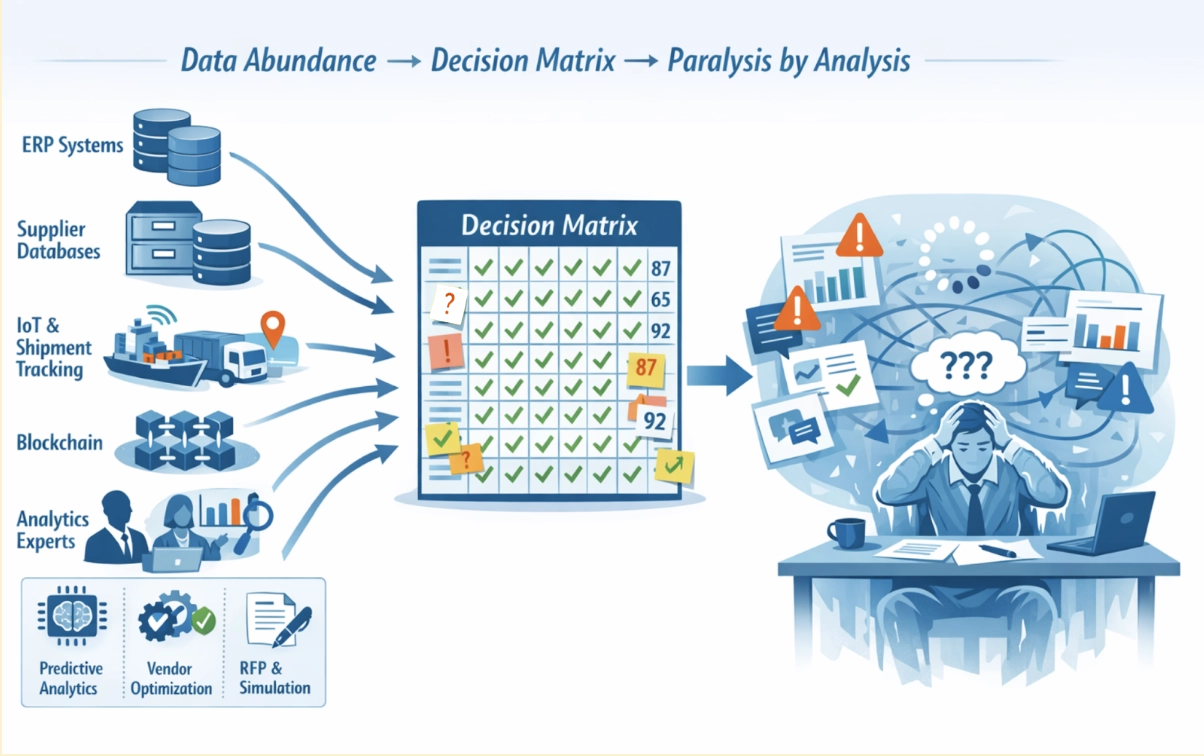
We're in an era of data abundance. Procurement departments are swimming in information from ERP systems, supplier databases, IoT sensors tracking shipments in real-time, and blockchain for transparent sourcing. Add to that the hiring spree of analytics experts. Data scientists and procurement analysts tasked with the job of uncovering hidden patterns.
And more recently, we have AI tools that process vast datasets at lightning speed, generating insights faster than any human could. Predictive analytics can forecast supply disruptions before they happen, machine learning algorithms optimize vendor selection, and generative AI even drafts RFPs or simulates negotiation scenarios.
More Data = Better Decisions?
It sounds like a dream, right? More data means better decisions, reduced risks, and smarter strategies. In many cases, it does. Analytics have revolutionized procurement by identifying cost-saving opportunities, mitigating supply chain vulnerabilities, and enhancing sustainability efforts. But (to quote Hamlet again), here's the rub: is all this gathering and analyzing really helpful, or is it fueling a wave of modern paralysis?
The answer is, it depends. The sheer volume of data can overwhelm. What starts as a quest for clarity turns into a rabbit hole of endless "what-ifs." Teams hire more experts (and expensive consultants) to handle the influx, but that often leads to more opinions, more reports, and more debates. AI, for all its speed, can exacerbate this by spitting out thousands of potential scenarios in seconds. Great for exploration, but disastrous if it leads to indecision. In a crisis, when time is of the essence, this hyper-analysis can erode agility.
It's like the fox with too many escape routes: the more options AI uncovers, the harder it becomes to pick one and run with it.
Moreover, not all data is created equal. In the rush to analyze everything, teams might chase irrelevant metrics or get bogged down in analysis paralysis loops, where insights lead to more questions rather than resolutions. A study by McKinsey found that while data-driven organizations are more profitable, many struggle with decision fatigue from information overload. In procurement, this manifests as delayed contracts, missed volume discounts, or failure to respond to urgent needs.
The irony is that all that technology meant to accelerate decisions can instead create bottlenecks, turning agile teams sluggish.
Breaking Free of the Data Trap
Start with knowing what to do with the data you've gathered. Not every byte needs scrutiny. Focus on KPIs that align with your goals. For procurement, that might mean prioritizing metrics like supplier reliability, total cost of ownership, and lead times over exhaustive market trend analyses. Implement data governance frameworks to filter noise. Use dashboards that highlight actionable insights, not exhaustive reports. Train teams to ask, "Does this data change our decision?" If not, set it aside.
Next, turn insights into action. Analysis reveals patterns, but patterns are worthless without follow-through.
- Establish clear decision-making protocols, like the 80/20 rule. Make a call once you have 80% of the information, knowing the last 20% might not add proportional value.
- In crises, adopt agile methodologies borrowed from software development. Break decisions into sprints, with rapid prototyping of options like piloting a small order with an alternative vendor to test the water quickly.
- Shortlist possible courses of action. With AI generating myriad options, use structured tools to narrow them down. Techniques like decision matrices can cut through the clutter.
- Encourage "pre-mortems" where teams imagine a decision failing and work backward to mitigate risks, fostering proactive thinking without over-analysis.
Leadership plays a huge role here, too. Empower procurement managers with decision authority, reducing layers of approval that breed delays. Companies like Amazon exemplify this with their "bias for action" principle, where speed trumps perfection in procurement decisions.
Consider training the team to recognize paralysis signs, such as endless meetings and deferred decisions, and counter them with time-bound processes.
Finally, remember Churchill's wisdom: perfection spells paralysis. In procurement, especially during crises, good enough often beats perfect. By streamlining how we gather, interpret, and act on data, we can reclaim agility.
One Decision You Don’t Need to Overanalyze!
One easy decision? Saving 18-22% as a GPO member! Become an Una member and access the resources you need to make the best sourcing decisions for your organization while saving more money, time, and effort.
Learn more here.


