

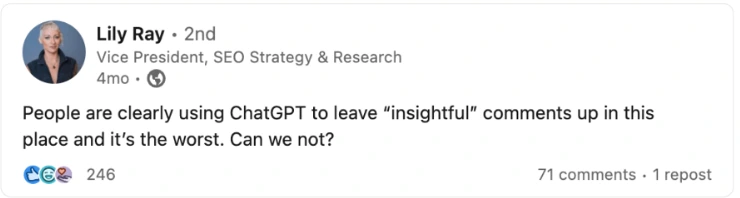
If the zeitgeist on LinkedIn is anything to go by, the long-expected pushback against ChatGPT and other LLMs has arrived:
This LinkedIn user is complaining about this sort of post, representing the platform's version of “AI slop”:
And this:
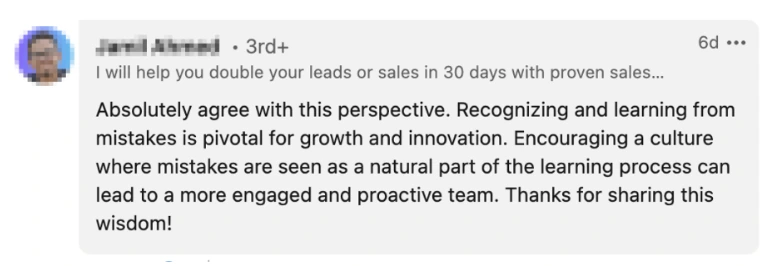
It seems that after an initiative surge of enthusiasm for LLM content, half the population of LinkedIn has come to realize that comments like these add little to no value.
As a rule, LLM users tend to regurgitate stuff everybody already knows, with an instantly recognizable tone of voice that comes across as “mansplaining” the obvious.
People Are Getting Better at Smelling LLM Content
The other issue is that LLM content is becoming easier to spot. Or, rather, it’s staying the same but readers are getting better at recognizing it. Clues include:
- Overuse of the EM dash (Although, to be fair, many writers liberally sprinkled their copy with EM dashes before AI was even a thing. They’re now upset that doing so may lead to accusations of using ChatGPT).
- Overused phrases such as “In the busy world of [industry]”, “It’s not just A, it’s B,” and marker words such as “crucial” and “delve”.
- Content is vague on current events.
- Everything is just too polished, structured, overconfident in tone, and predictable.
We’ve Just Reached a Tipping Point
This chart generated a lot of attention in 2025, when AI-generated content surpassed human content.
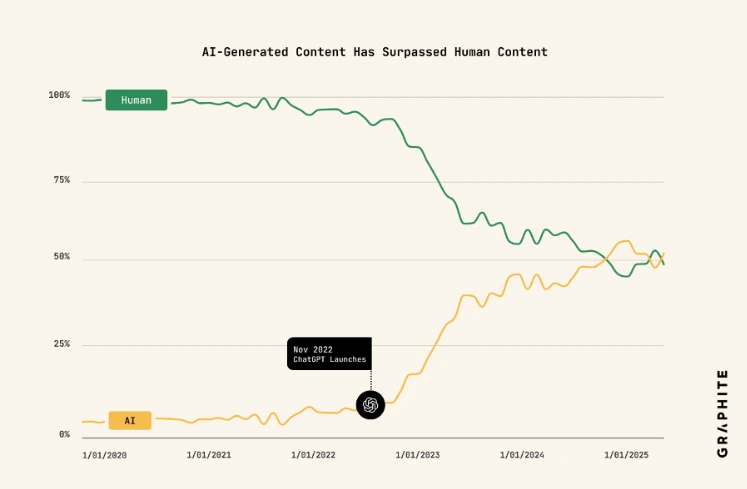
A caveat here: We don’t know what software the researchers used to identify AI-generated content, but what we do know is that LLM detectors are hit-and-miss.
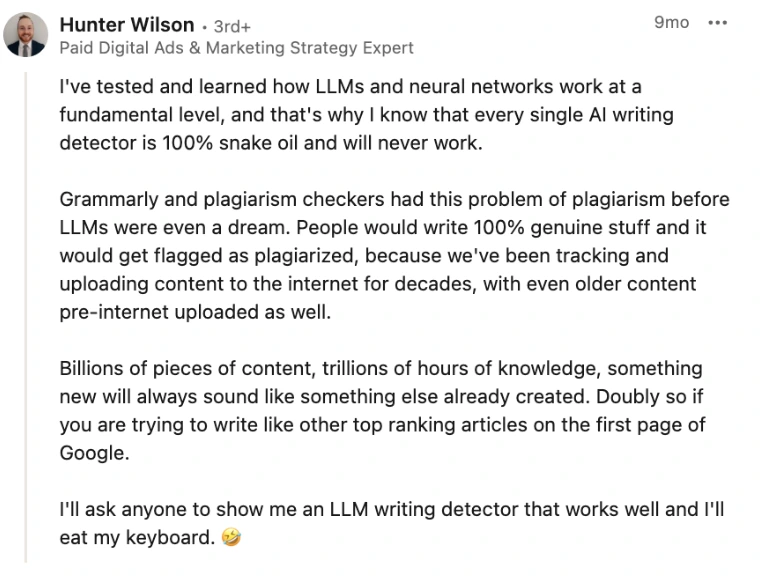
Graphite may have come up with false positives; that is, they identified 100% human content as AI. LinkedIn user Hunter Wilson explains why in this post:
Human Error is Now a Good Thing
Was Alexander Pope thinking about LLMs when he wrote that “to err is human”? Given the year was 1711, probably not. But his words ring true.
As part of the pushback against LLM slop, writers and their audiences are beginning to celebrate human error: spelling mistakes (often inserted deliberately), dodgy grammar, or jumpy sentence structures are now clapped rather than criticized.
I’m aware of this even as I write this article: the structural flow of this piece isn’t 100% smooth, I’m relying a little too heavily on screenshots to make my point, and it's taken me way too long to get around to talking about procurement.
Let’s rectify that. Next up: how LLMs are used in procurement, and how they could be damaging your relationships.
Using LLMs in Procurement
Reporting and Category Planning
Massive time-saver? Yes. But although LLMs can generate informative reports or provide outlines for category plans, they lack human nuance and the spark that can lead to an ‘aha!’ insight. An LLM might draft a well-structured category plan, but without the human touch to enrich the text, it can lead to an uninspired and generic framework. "Cookie-cutter" responses like this inevitably diminish the value that innovative thinking brings.
LLMs for Relationship Building
Exercise caution when relying on LLMs to build relationships with suppliers and stakeholders! Over-dependence on LLMs can hinder the development of meaningful connections, relegate interactions to the transactional level, and prevent procurement from reaching its goal of becoming a truly strategic function.
Supplier Communication
Consider the common use of AI-generated autoreplies in supplier communication.
Thank you for sending this information. I will review the attached document and follow up with any questions I may have after going through it thoroughly.
Yes, this kind of generic reply may serve its purpose in terms of acknowledgment, but it does little to cultivate trust or rapport. Suppliers love tailored communication that reflects an understanding of their businesses and challenges. Spewing out uniform responses flags a sense of apathy toward relationship building.
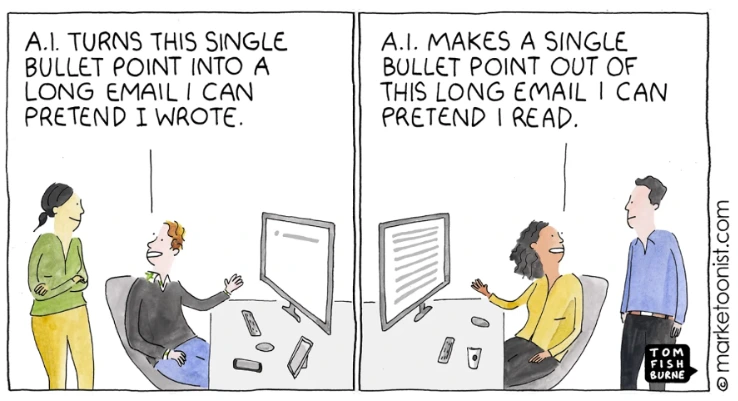
Here's a tip for better relationships via email: Always try to match the effort that your correspondent has produced. That is, don’t reply to a 100-word email with a 5-word answer.
Stakeholder Engagement
The same pitfalls exist in stakeholder communication. If our goal, as a profession, is to evolve beyond a reactive function and become proactive problem-solvers, we need to understand our business stakeholders deeply.
We need to live and breathe their priorities, challenges, lingo, and preferred communication styles. Sending AI-generated emails traps us into a cycle of passive engagement.
Smarter Chatbots
Chatbots are a different matter, because they’re designed to handle the transactional, everyday queries from people in the business about procurement policy or procedure. The end-goal is to create an Alexa-like assistant which will respond when someone says “Hey, Procurement!”.
Everyone wins: stakeholders get their questions answered faster, and you can focus on the strategic, relationship-building stuff.
But! Don’t let chatbots become a substitute for genuine interaction, because that will mean missed opportunities for engagement. Make sure there’s always an option for chatbot users to contact you (the human). Ask the chatbot to report on what questions are most commonly asked, and the areas where it hasn’t been able to help people. This, in turn, will help you plug any knowledge or education gaps.
Keep Using LLMs But Not at the Expense of Relationships
Relying too heavily on LLMs in procurement will stifle creativity, stunt relationships and hinder the discovery of new value. Keep using AI, but be sure to prioritize human interactions and emphasize authentic engagement.
Remember, relationships are the heart of procurement.
And finally, here’s a funny prediction of what might happen if people keep using ChatGPT instead of thinking for themselves.
If you're needing a creativity boost or help building meaningful supplier relationships, contact our team to learn how a GPO can help.


